DOT brass fitting suppliers can look very similar when I only compare unit price, but the lowest quote can hide costly risks. A few cents saved may turn into delayed replenishment, rejected batches, unclear compliance, or customer complaints. The better approach is to compare suppliers by total procurement risk, not price alone.
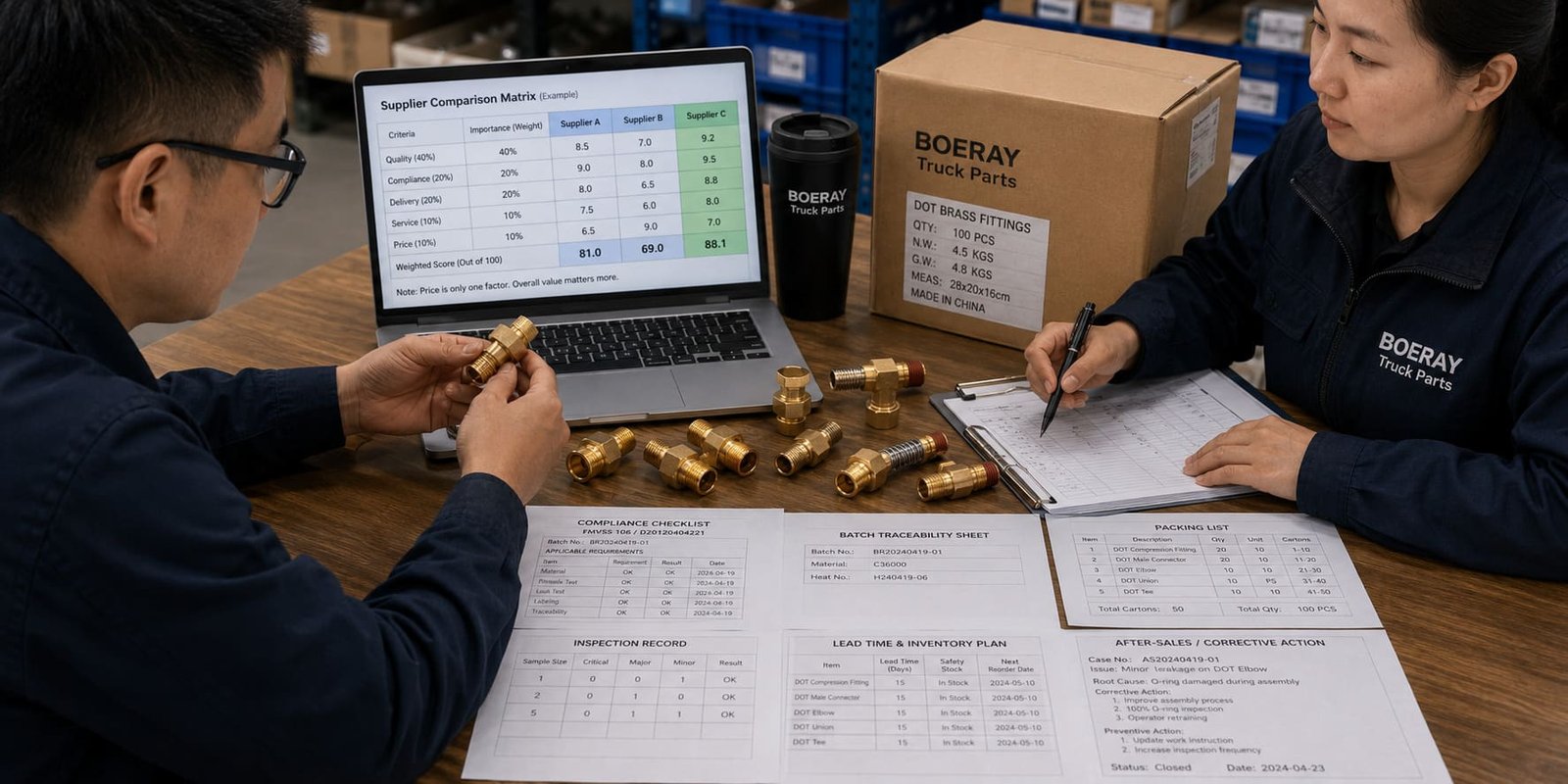
To compare DOT brass fitting suppliers beyond unit price, I check five areas: compliance documentation, sample-to-batch consistency, production quality control, delivery reliability, and after-sales response. A good supplier should help reduce hidden costs through traceable materials, stable testing, clear lead times, flexible order support, and fast communication when problems happen.
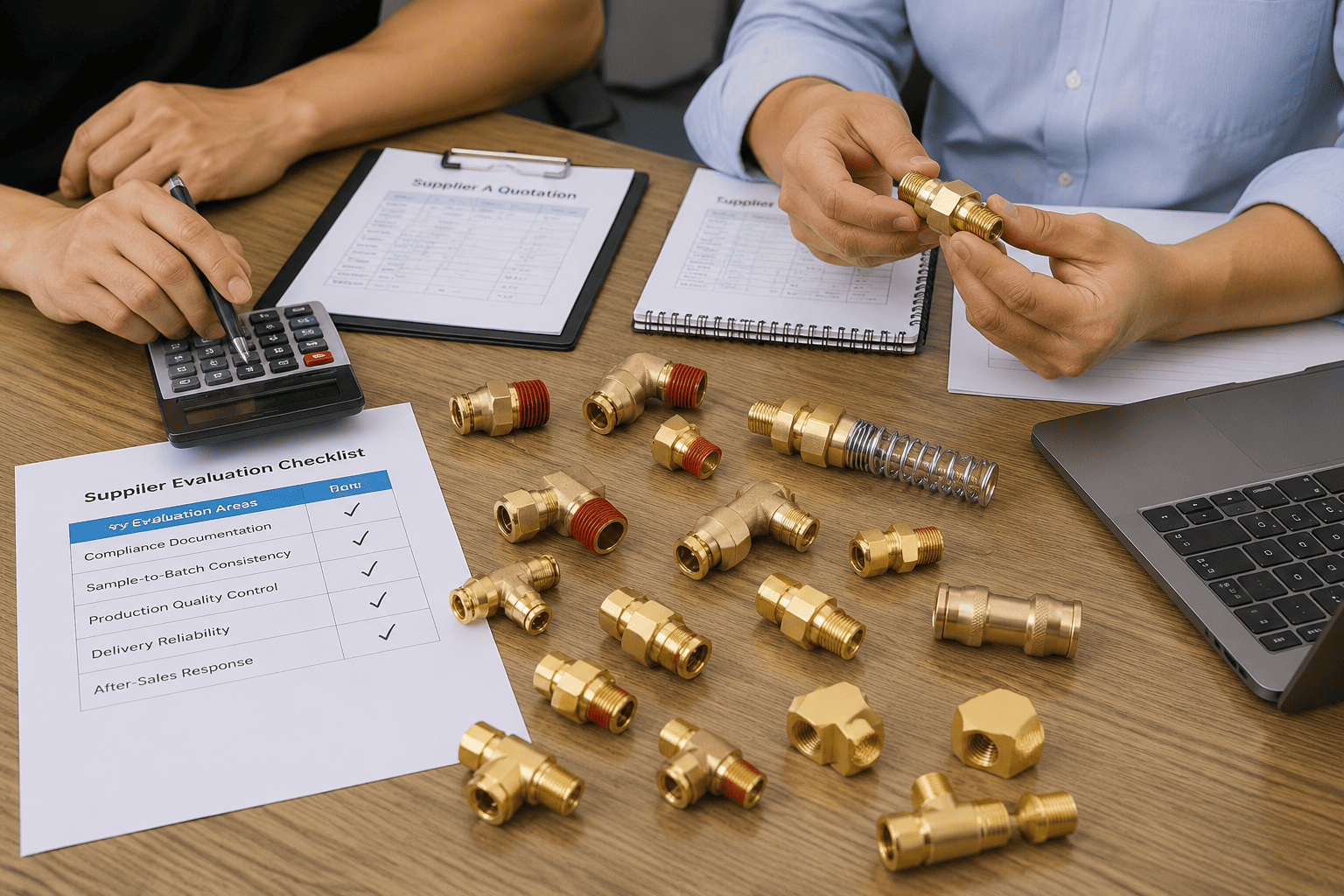
Unit price still matters. I negotiate it every day with buyers. However, I have learned from real inquiries and after-sales cases that price is only the first filter. The real question is simple: which supplier protects your inventory, customers, and reputation after the purchase order is placed?
Why Should DOT Brass Fitting Suppliers Be Compared Beyond Unit Price?
A low quote can feel like an easy win, but I have seen buyers lose that advantage when the real cost appears later. If fittings arrive late, leak during use, or require re-sorting before resale, the “cheap” order becomes expensive very quickly.
The best way to compare DOT brass fitting suppliers is to calculate the full cost of ownership1. This includes defect risk, compliance uncertainty, inspection workload, packaging quality, logistics fees, replenishment speed, and after-sales handling2. A slightly higher unit price may be lower-cost if the supplier reduces these risks consistently.
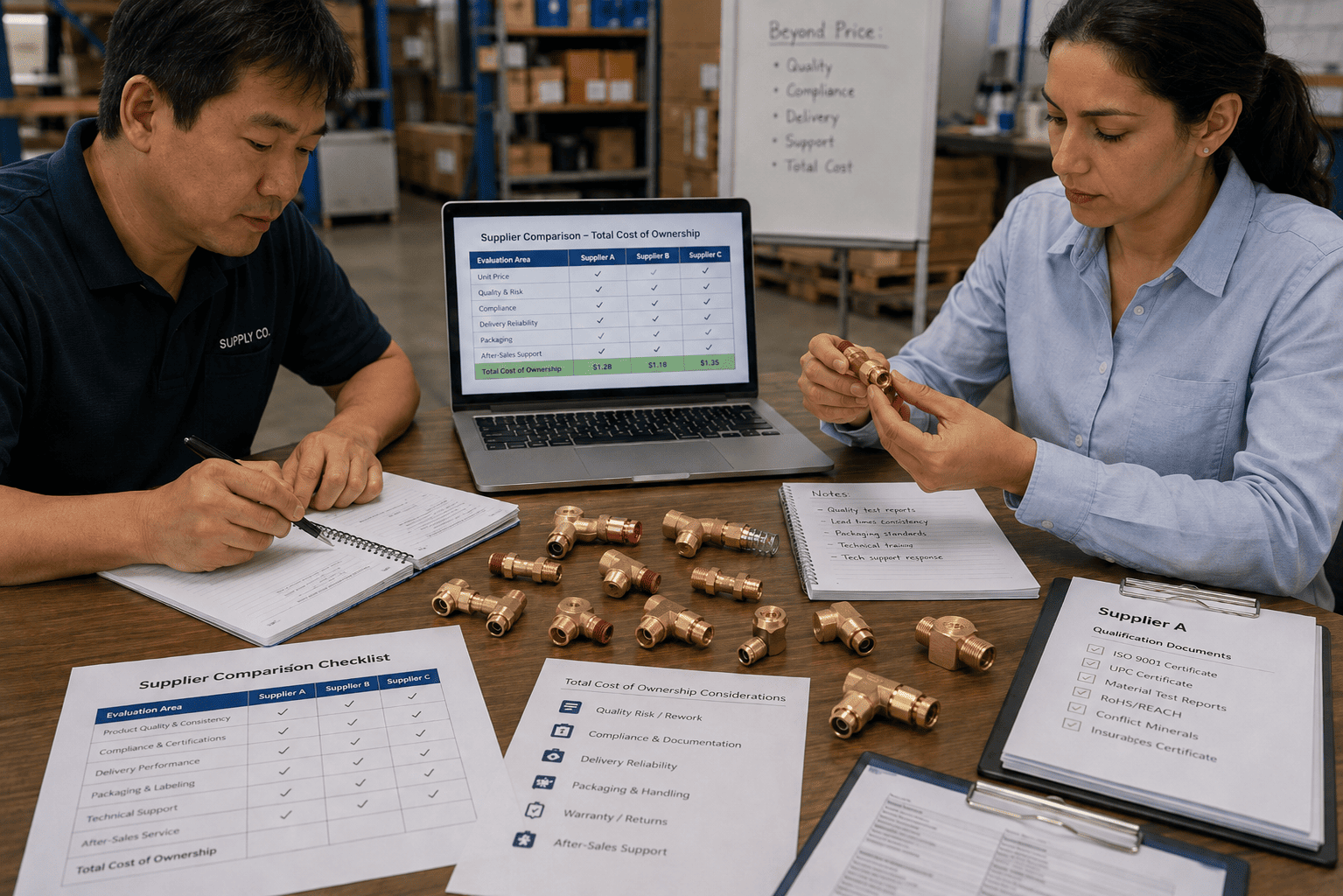
Unit price is only the visible number
When a buyer sends me a spreadsheet, I usually see columns for size, thread type, quantity, and target price. That is normal. Procurement teams need clear numbers. But I also ask buyers to think about the numbers that do not appear on the first quotation.
Hidden costs often include:
- Defect sorting cost when warehouse teams must inspect every carton.
- Customer return cost when downstream buyers find thread or sealing problems.
- Inventory cost when delayed shipments create emergency purchases.
- Compliance risk when documents do not match the target market.
- Communication cost when drawings, substitutions, or claims take too long.
- Packaging loss when mixed SKUs are not labeled clearly.
I once handled an anonymous inquiry where the buyer already had a very low price from another source. The issue was not the price. The issue was that the buyer could not confirm whether the fittings were suitable for the U.S. brake system channel. The buyer also had no clear answer about batch testing, carton labels, or replenishment timing. In that case, the unit price was real, but the procurement risk was also real.
A simple hidden cost comparison
| Cost Driver | Low-Risk Supplier Signal | High-Risk Supplier Signal |
|---|---|---|
| Compliance | Provides relevant DOT/FMVSS 106 documents for review | Only says “yes, we have DOT” |
| Batch quality | Uses material checks, thread gauges, pressure tests, final sampling | Sends good samples but gives no batch control details |
| Delivery | Gives clear lead time and updates production status | Confirms order, then becomes silent |
| SKU handling | Supports mixed cartons, labels, and stable packing lists | Ships confusing mixed items without clear marking |
| After-sales | Responds with photos, batch data, and corrective action | Blames buyer or delays response |
The procurement lesson I use
I do not believe “cheap is bad” or “expensive is good.” That is too simple. Some suppliers have strong cost control because they run efficient production, buy brass material well, and reduce waste. That can create a fair low price.
However, I always separate real cost advantage from risk transfer.
A supplier may reduce the quote by removing inspection steps, using unclear material sources, skipping packaging details, or avoiding after-sales responsibility. In that case, the supplier is not reducing cost. The supplier is moving risk to the buyer.
For truck parts wholesalers, hardware importers, and repair-channel buyers, that risk can damage trust. One leaking fitting complaint may cost more than the savings on thousands of pieces. So when I compare DOT brass fitting suppliers, I start with price, but I never stop there.
How Should DOT Brass Fitting Suppliers Prove Compliance Clarity?
Compliance claims can be confusing, especially when buyers source from overseas. I often hear the question, “Do you have DOT?” That question is useful, but it is not enough. A buyer needs documents, scope, batch records, and market applicability checked before placing trust in a supplier.
DOT brass fitting suppliers should support compliance review with relevant DOT and FMVSS 106 documentation3, test records, product identification details, and traceability information. Buyers should verify whether the documents apply to the specific fitting type, application, production batch, and target market. I do not treat a verbal claim as proof.
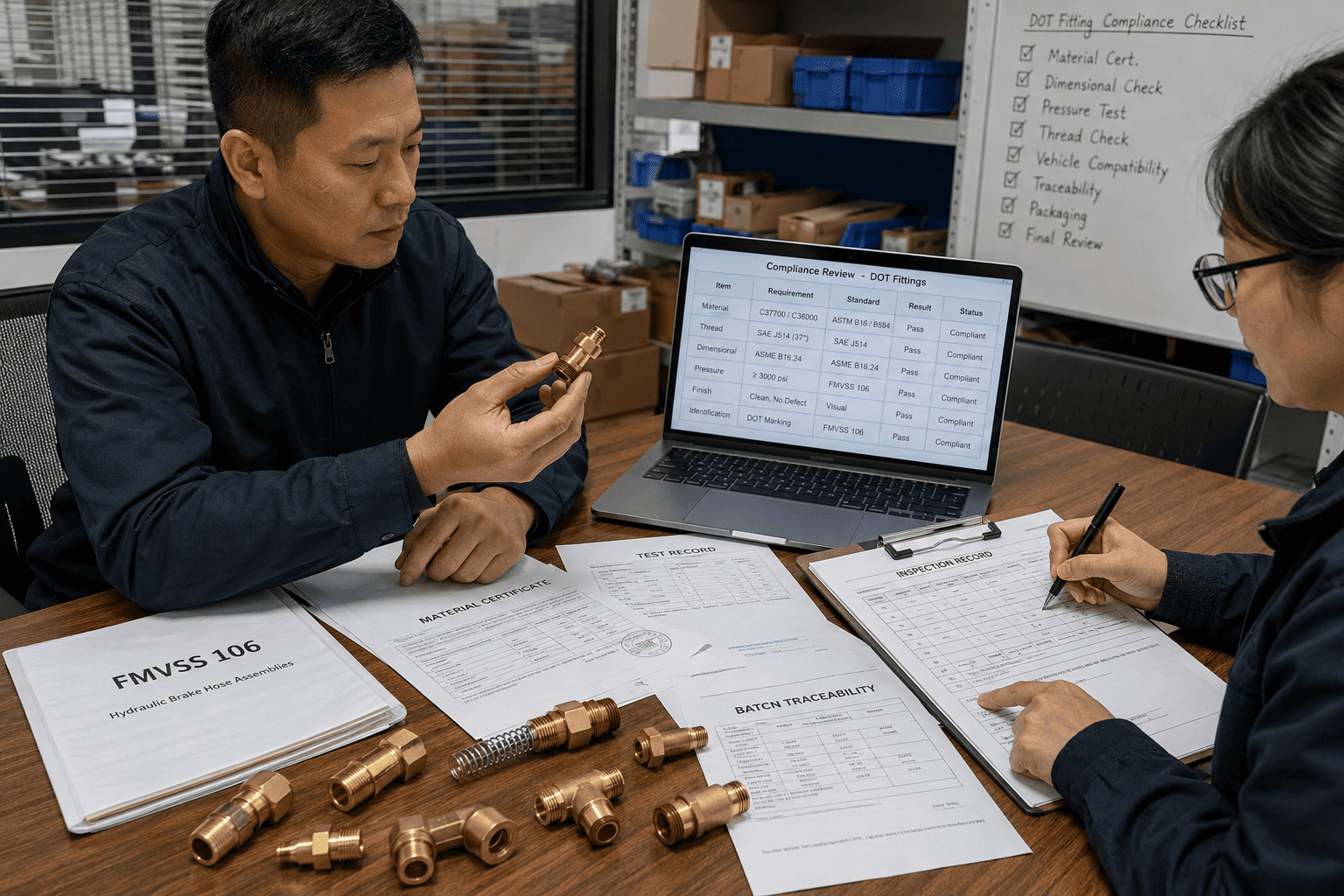
Ask better questions than “Do you have DOT?”
In North American truck parts channels, DOT-related fittings are not just general hardware. Many buyers serve air brake, trailer, and heavy-duty repair markets. That means documentation matters. I am not a regulator or certification laboratory, so I always encourage buyers to verify documents and applicability with their own compliance team or third-party specialists when needed.
Still, procurement teams can ask very practical questions.
Use questions like:
- Which standard or requirement does this product claim to meet?
- Can you provide relevant DOT/FMVSS 106 documents for review?
- Does the document cover this fitting series, size, and thread type?
- Can you provide recent test records or batch inspection records?
- Can the product packaging or label match my market needs?
- Do you keep traceability from raw material to finished goods4?
These questions are simple, but they reveal a lot. A serious supplier should not be surprised by them.
What documents should buyers request?
The exact document package depends on the product and market. However, I usually see buyers request a combination of the following:
| Document or Record | Why It Matters | What I Would Check |
|---|---|---|
| DOT-related document | Shows claimed regulatory basis | Product scope, company name, validity, applicability |
| FMVSS 106-related information | Relevant for brake hose/fitting market review | Whether the claim matches the product category |
| Material certificate | Supports brass material verification | Brass grade, batch number, supplier record |
| Test record | Shows performance checks | Air tightness, pressure test, thread inspection |
| Batch traceability record | Helps investigate problems | Production date, material lot, inspection result |
| Packing list and labels | Prevents warehouse confusion | SKU, size, quantity, carton mark |
Why compliance clarity reduces cost
Compliance problems are expensive because they usually appear late. A buyer may only discover a gap after the goods arrive, after a customer asks for documents, or after a shipment is prepared for resale. At that point, the cost is not just the product value. The cost may include storage, relabeling, testing, delayed sales, or even returning goods.
I have seen buyers become much more confident when a supplier can explain the difference between a product claim, a document scope, and a batch inspection record. That explanation does not replace legal or regulatory review. But it helps the procurement team avoid blind decisions.
Practical supplier-audit signals
When I evaluate DOT brass fitting suppliers from a buyer’s viewpoint, I look for these signals:
- The sales team can explain documents without overpromising.
- The factory keeps inspection records by batch.
- The supplier can connect samples, drawings, and production items.
- The supplier can provide photos or videos of testing when appropriate.
- The supplier does not avoid questions about standards or applications.
A strong supplier will say, “Here is what we can document. Please verify this against your market requirements.” A risky supplier may say only, “No problem, all compliant,” without proof. I prefer the first answer because it is more professional and more useful.
Can DOT Brass Fitting Suppliers Match Sample Quality in Mass Production?
A perfect sample does not guarantee perfect mass production.5 I have sent and received enough samples to know this. Samples are often made carefully, sometimes in small quantities, and sometimes by the most experienced operators. The real test begins when thousands of pieces must match the same standard.
DOT brass fitting suppliers should prove sample-to-batch consistency through material inspection, thread gauge checks, air-tightness testing, pressure testing, in-process records, and final AQL-style sampling6. Buyers should approve samples, then confirm that mass production follows the same drawing, material, tolerance, and inspection plan.
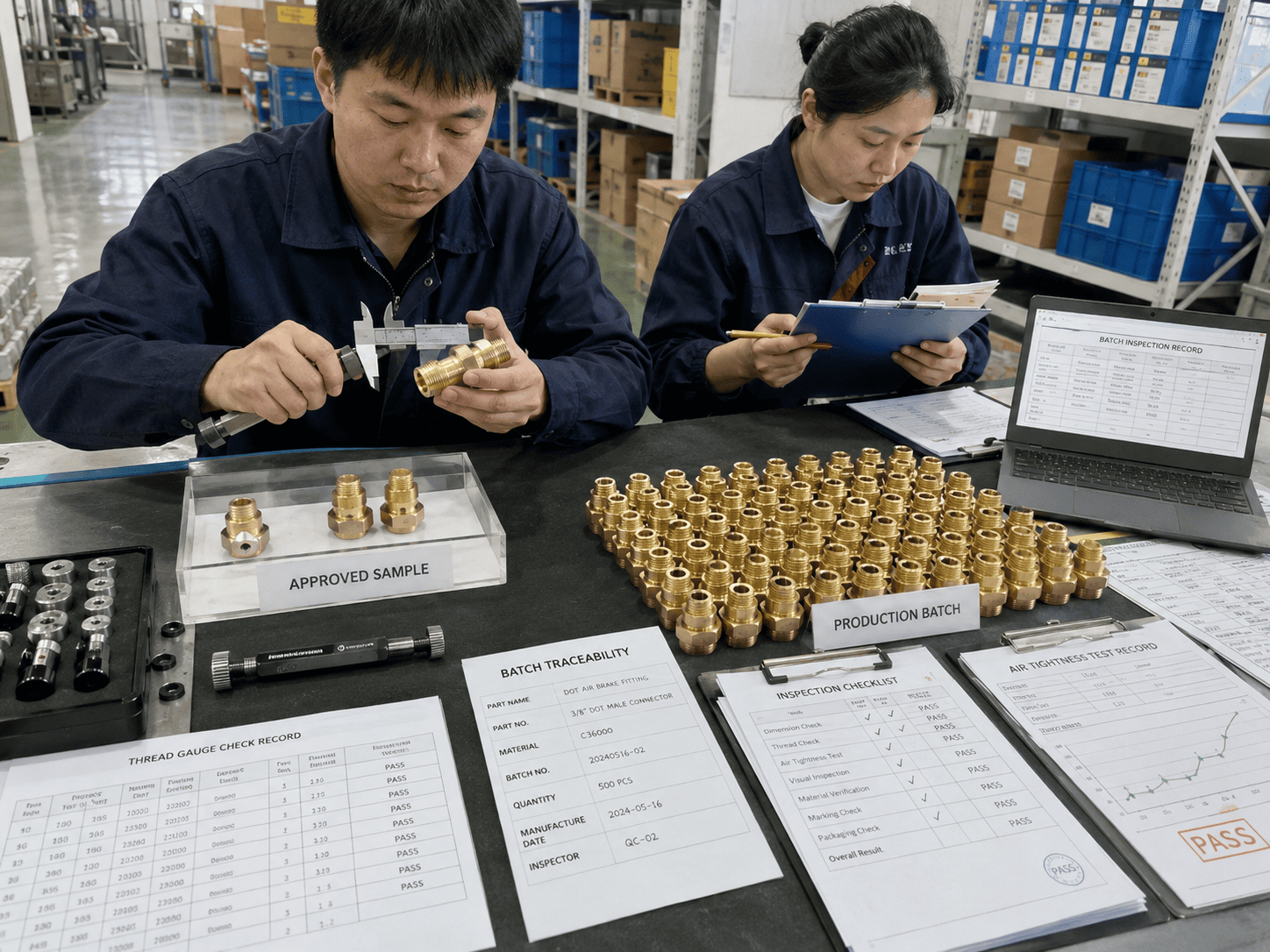
Sample approval is the start, not the finish
Sample approval is important. I never suggest skipping it. For new fittings, custom dimensions, private labels, or OEM/ODM orders, samples help both sides confirm shape, thread, finish, packaging, and fit. However, samples answer only one question:
“Can this supplier make a correct piece once?”
Mass production asks a harder question:
“Can this supplier make the same correct piece 10,000 times?”
Those two questions are very different.
What I check during production
In brass fitting manufacturing, small details matter. Thread precision, sealing surface, chamfer, burr control, and cleanliness can all affect performance.7 That is why buyers should ask about process control, not just final appearance.
Useful control points include:
- Raw material inspection: Check H59/H62 brass bars, material certificates, and copper content where applicable.
- CNC turning control: Confirm dimensions during production, not only after completion.
- Thread inspection: Use thread gauges to verify NPT, DOT-related, or other specified threads.
- Air-tightness testing: Check sealing performance according to the supplier’s inspection plan.
- Pressure resistance testing: Confirm test pressure and method, such as 500 PSI where appropriate for the supplier’s product process.
- Salt spray testing: Review corrosion-resistance testing when surface treatment is relevant.
- Final sampling: Use AQL-style inspection before warehousing or shipment.
These steps do not make every supplier identical. But they show whether the factory has a repeatable system.
Sample-to-batch comparison checklist
| Item | Sample Stage | Mass Production Stage |
|---|---|---|
| Drawing | Confirm dimensions and thread type | Lock revision and prevent unauthorized changes |
| Material | Confirm brass grade request | Verify incoming brass batch |
| Thread | Check fit and gauge result | Inspect at set frequency during production |
| Sealing | Test sample performance | Conduct batch air-tightness tests |
| Surface | Confirm finish and cleanliness | Monitor burrs, scratches, plating, or oxidation |
| Packaging | Approve label and carton style | Match approved packing standard |
Why batches drift
Batch problems do not always happen because a supplier is careless. Sometimes they happen because the process is not controlled tightly enough. Tool wear can change dimensions. Thread taps can wear down.8 Operators may interpret drawings differently. Material lots can vary. Rush orders can reduce inspection discipline.
This is why I like factories with full-process records. When an issue appears, the supplier can trace it back to a production date, machine, operator, material lot, or inspection record. Without traceability, after-sales discussion becomes guesswork.
What buyers should request before bulk orders
Before placing a large order, I suggest buyers ask:
- Will mass production use the same drawing as the approved sample?
- Can you provide pre-production confirmation photos?
- What inspection points are recorded during production?
- What is the sampling plan before shipment?
- Can I arrange third-party inspection if needed?
- How do you handle nonconforming pieces?
These questions help buyers compare DOT brass fitting suppliers based on production stability. They also create clear expectations before money and time are committed.
Which Delivery and Inventory Factors Separate Reliable DOT Brass Fitting Suppliers?
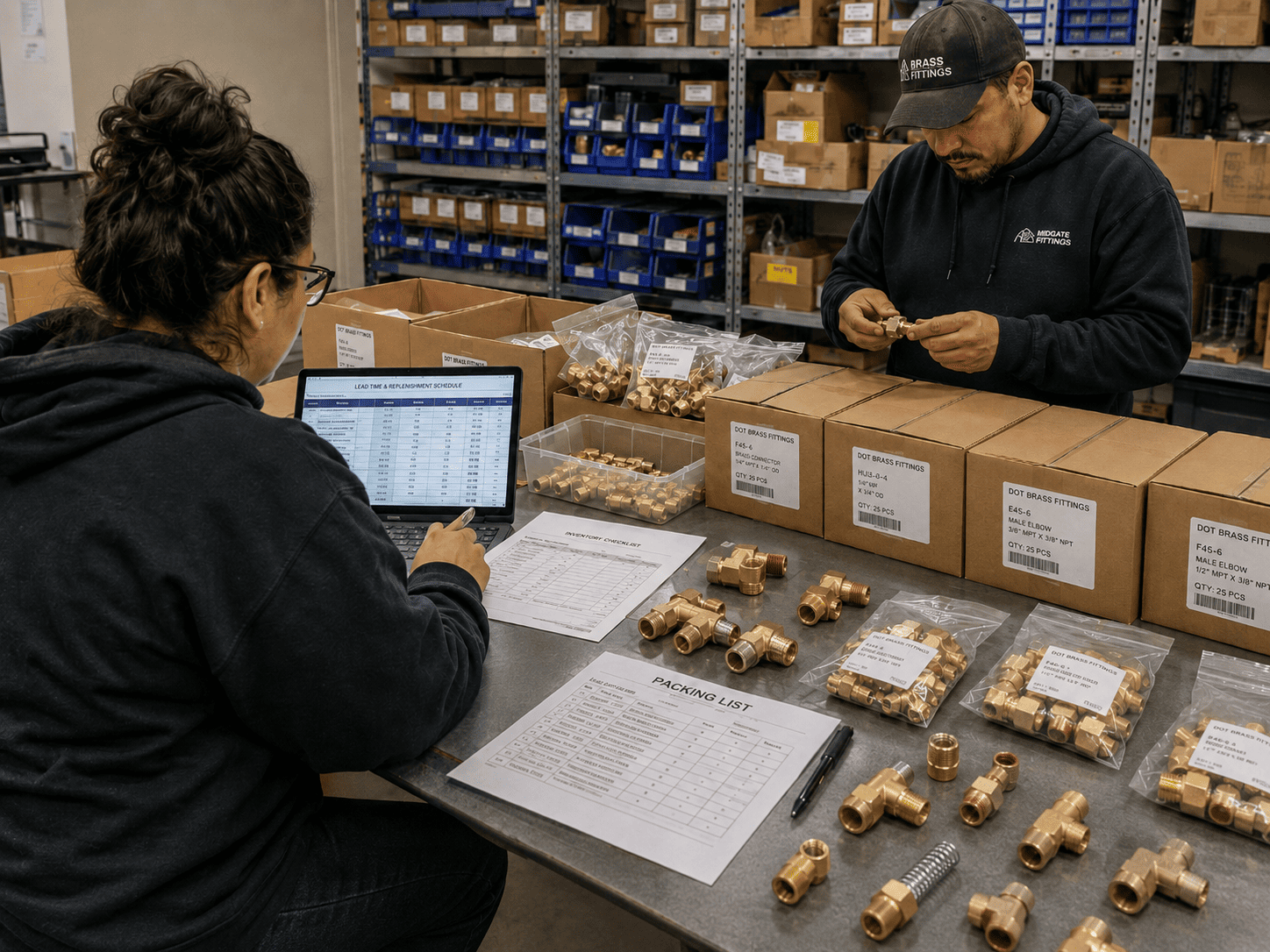
A supplier can make good products and still create problems if delivery does not match the buyer’s inventory plan. I hear this often from wholesalers. They need fittings in stock before customers ask. Late replenishment can force emergency buying, lost sales, or awkward conversations with key accounts.9
Reliable DOT brass fitting suppliers support procurement operations with realistic lead times, MOQ flexibility, SKU coverage, rolling stock for standard items, mixed-order handling, clear packaging, and logistics coordination. Delivery reliability is not only about shipping fast. It is about helping buyers plan inventory with fewer surprises.
Operational fit matters
Procurement is not only product selection. It is also inventory management. A buyer may need 50 SKUs, but not all SKUs move at the same speed. Some sizes sell every week. Others move slowly but must be available to complete a product range.
This is where operational fit becomes important. I have seen buyers choose a supplier not because that supplier had the lowest price on one item, but because the supplier could support the full purchasing rhythm.
Important questions include:
- Can the supplier support mixed SKU orders?
- Does the supplier offer flexible MOQs for slow-moving items?
- Can the supplier maintain stock for standard fittings?
- Is lead time stable during busy seasons?
- Can the supplier support FOB, DDP, or other logistics methods?
- Does the supplier provide carton marks that match warehouse needs?
MOQ flexibility can protect cash flow10
Large wholesalers may order full containers. Smaller retailers or repair-channel buyers may need mixed cartons. Both are valid. The best supplier is not always the one with the lowest MOQ or the highest capacity. The best supplier is the one whose order model fits the buyer’s business.
Here is a simple comparison:
| Buyer Type | Common Need | Supplier Support to Check |
|---|---|---|
| Truck parts wholesaler | Full range, stable replenishment | SKU coverage, bulk pricing, delivery schedule |
| Hardware importer | Mixed products, clear labeling | Packaging options, carton marks, consolidation |
| OEM/ODM buyer | Custom drawing, repeat batches | Engineering support, sample control, traceability |
| Small retailer | Low MOQ, quick restock | Stock items, mixed orders, flexible packing |
| Industrial distributor | Consistent specs, documentation | Test records, material data, technical response |
Lead time should be realistic
I prefer a realistic lead time over an optimistic promise. If production needs 25 days, the supplier should say 25 days. If surface treatment or special packaging adds time, the supplier should explain it before order confirmation.
Unrealistic lead times create a chain reaction:
- The buyer gives customers a wrong delivery promise.
- The goods are not ready on time.
- The buyer must pay more for urgent logistics or split shipments.
- The customer loses confidence.
- The next purchase becomes harder to plan.
For export orders, logistics also matters. A supplier close to a major port can have an advantage, but location alone is not enough. The supplier still needs good coordination with forwarders, accurate packing lists, and fast document preparation.
Packaging is not a small detail
I have learned that packaging mistakes can become warehouse problems. A carton with unclear labels may slow receiving. Mixed sizes without separation may cause picking errors. Weak cartons may break during sea transport. Private-label buyers may also need brand-consistent packaging.
Useful packaging details include:
- Item number and size on each bag or box.
- Carton label with SKU, quantity, and batch information.
- Palletization for larger orders.
- Barcode support when required.
- Neutral or customized packaging options.
- Clear packing list that matches invoice and shipment documents.
When buyers compare DOT brass fitting suppliers, they should treat packaging as part of the product. A fitting that cannot be identified quickly in the warehouse creates cost, even if the unit price is attractive.
What After-Sales Questions Should Buyers Ask DOT Brass Fitting Suppliers?
Many buyers focus on the pre-order stage because that is where price negotiation happens. But I always pay attention to what happens after shipment. If a problem appears, the supplier’s response speed and problem-solving attitude can decide whether the buyer loses a customer or keeps trust.
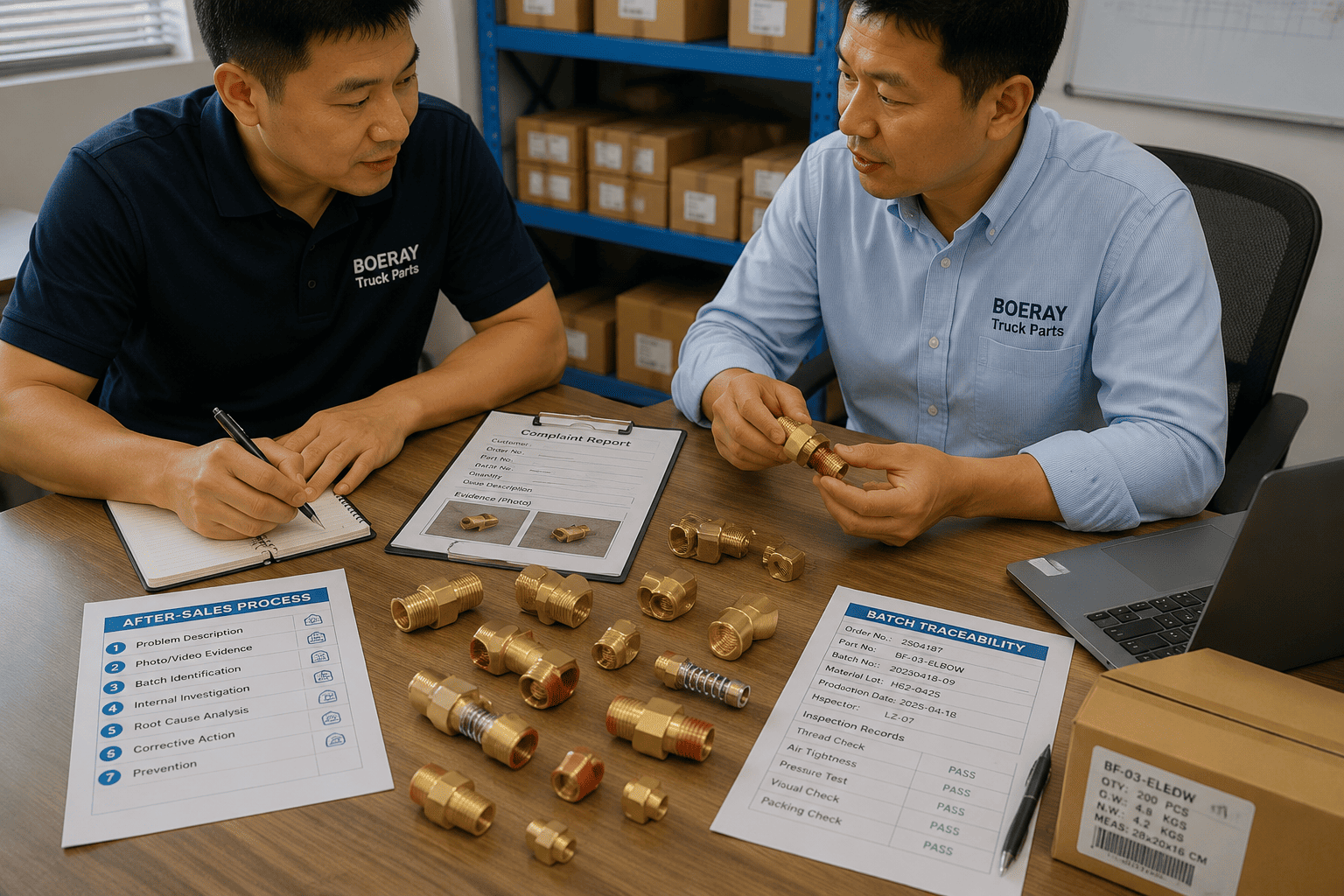
Buyers should ask DOT brass fitting suppliers how they handle complaints, defective pieces, batch tracing, replacement parts, credit notes, technical questions, and corrective actions. A professional supplier should respond with evidence, not excuses. Good after-sales support reduces downtime, claim disputes, and repeat quality problems.
Problems need process, not emotion
No manufacturer should pretend that problems never happen. Brass fittings are precision components, and every supply chain has variables. The difference is how the supplier handles issues when they appear.
I respect buyers who report problems with clear photos, quantities, lot numbers, and application details. I also respect suppliers who answer quickly and investigate seriously. The worst situation is when both sides argue without data.
A good after-sales process usually includes:
- Problem description: What happened, where, and in what quantity?
- Photo or video evidence: Show thread, surface, leakage point, package, or label.
- Batch identification: Confirm order number, production batch, and carton marks.
- Internal investigation: Check inspection records, operators, tools, and material lot.
- Root cause analysis11: Identify whether the issue is production, packaging, transport, or application-related.
- Corrective action: Replace, credit, rework, improve process, or update inspection.
- Prevention: Add control points for future batches.
Response speed matters
When a truck parts distributor receives a complaint, time matters. The end customer may be a repair shop, fleet maintenance team, or retailer. They do not want a long silence. They want a clear answer.
That is why communication speed should be part of supplier evaluation. Before choosing a supplier, I suggest buyers test communication in normal situations:
- How fast does the supplier reply to drawings?
- Can the supplier explain specifications clearly?
- Does the supplier confirm thread standards before quoting?
- Does the supplier warn about possible substitutions?
- Can the supplier provide production updates without repeated chasing?
A supplier that communicates well before the order is more likely to communicate well after the order. It is not guaranteed, but it is a good signal.
A practical after-sales scorecard
| Evaluation Point | Strong Signal | Weak Signal |
|---|---|---|
| Complaint response | Replies within a clear time frame | Delays or avoids responsibility |
| Evidence handling | Requests photos, batch data, and quantities | Gives opinions without investigation |
| Traceability | Links issue to material or production batch | Cannot identify production source |
| Corrective action | Offers replacement, credit, or process improvement when justified | Only offers discount on next order |
| Technical support | Discusses drawings, threads, and application limits | Gives vague answers |
Why after-sales affects long-term cost
After-sales support is part of total cost because it affects customer retention. If a distributor solves a problem quickly, the customer may continue buying. If the distributor cannot get support from the supplier, the customer may switch brands.
I have seen buyers continue working with a supplier after a problem because the supplier responded fast, investigated honestly, and improved the next batch. I have also seen buyers leave suppliers after small issues because the supplier ignored them.
For me, a reliable supplier does not need to be perfect. A reliable supplier needs a system that makes problems visible, traceable, and correctable.
Frequently Asked Questions
What is the biggest mistake when comparing DOT brass fitting suppliers?
The biggest mistake is comparing only unit price without checking compliance documents, batch quality control, lead time, packaging, and after-sales support. A low quote can become costly if it creates customer returns, delayed inventory, or unclear market documentation.
Is sample approval enough before ordering DOT brass fittings?
No. Sample approval is only the first step. Buyers should confirm that mass production follows the approved drawing, material, thread standard, inspection plan, and packaging method. They should also request batch inspection records or arrange third-party inspection when needed.
What documents should I ask a DOT brass fitting supplier to provide?
Buyers should ask for relevant DOT/FMVSS 106 documentation, material certificates, test records, batch traceability information, and packing details. The exact requirements depend on the product and market, so buyers should verify document scope and applicability before relying on them.
How can I reduce risk when buying mixed SKU brass fitting orders?
I would confirm MOQ rules, SKU labels, carton marks, packing lists, and stock availability before ordering. Mixed orders need clear organization. Poor labeling can create warehouse picking errors12, even when the fittings themselves are acceptable.
Does a higher price always mean a better DOT brass fitting supplier?
No. A higher price does not automatically mean better quality. Buyers should compare the supplier’s process, documents, testing, lead time, and support. The best choice is the supplier that provides the strongest value and lowest procurement risk for the required market.
Conclusion
Comparing DOT brass fitting suppliers beyond unit price helps buyers avoid hidden costs in compliance, quality, delivery, inventory, and after-sales service. I still believe price negotiation is important, but I treat it as one part of a larger supplier-risk review. Before placing your next order, ask for documents, confirm batch controls, test operational fit, and evaluate communication speed. If you need a practical review of DOT brass fittings, custom parts, or mixed SKU sourcing, contact Yaochong for a clear quotation and supplier evaluation discussion.
"Analyzing Costs Using Total Cost of Ownership", https://psep.smeal.psu.edu/short-courses/supply-chain-accelerator/advanced-procurement-analyzing-costs-using-total-cost-of-ownership. Research on total cost of ownership in purchasing describes supplier evaluation as including costs incurred before, during, and after acquisition, supporting the article’s use of total procurement risk rather than unit price alone; the evidence is general procurement theory rather than a brass-fitting-specific cost model. Evidence role: general_support; source type: paper. Supports: Total cost of ownership is an established procurement framework for evaluating purchase decisions beyond quoted price, including quality, logistics, service, and administrative costs.. Scope note: The support is contextual because it addresses purchasing decisions broadly, not DOT brass fittings specifically. ↩
"Cost of Poor Quality Categories: How Supplier Defects Drive Hidden ...", https://www.autodesk.com/blogs/design-and-manufacturing/cost-of-poor-quality/. Quality-cost and supply-chain literature classifies inspection, defects, rework, returns, and delivery disruption as costs that may not appear in the purchase price, supporting the article’s inclusion of these factors in supplier comparison; the evidence is not limited to pneumatic or brake-line fittings. Evidence role: general_support; source type: paper. Supports: Quality failures, inspection, returns, logistics disruption, and service handling are recognized contributors to total purchasing and quality costs.. Scope note: The support is contextual because it validates the cost categories generally rather than quantifying them for this product. ↩
"Interpretation ID: 04-009159drn", https://www.nhtsa.gov/interpretations/04-009159drn. NHTSA’s FMVSS No. 106 sets federal requirements for brake hoses, brake hose assemblies, and brake hose end fittings, supporting the article’s statement that DOT/FMVSS 106 documentation is relevant when fittings are sold for brake-system use; applicability still depends on the exact product design and regulated use. Evidence role: definition; source type: government. Supports: FMVSS No. 106 is the U.S. federal motor vehicle safety standard covering brake hoses, brake hose assemblies, and related end fittings, making regulatory documentation relevant for brake-system applications.. Scope note: The regulation must be checked against the specific fitting type and application. ↩
"Supply Chain Traceability: Manufacturing Framework | CSRC", https://csrc.nist.gov/News/2024/supply-chain-traceability-manufacturing-framework. Quality-management standards and guidance describe identification and traceability as mechanisms for linking inputs, production records, and outputs, supporting the article’s use of raw-material-to-finished-good traceability as a supplier-audit signal; this does not by itself prove that a particular supplier’s records are accurate. Evidence role: general_support; source type: institution. Supports: Quality-management guidance recognizes identification and traceability as controls that help link materials, processes, and finished products for conformity and investigation.. Scope note: The evidence supports the quality-management principle, not any individual supplier’s implementation. ↩
"Statistical process control", https://en.wikipedia.org/wiki/Statistical_process_control. Statistical process control and process-capability references explain that production outputs vary and must be monitored over time, supporting the article’s distinction between an approved sample and consistent mass production; the support is general manufacturing theory rather than evidence from brass fitting factories. Evidence role: mechanism; source type: education. Supports: Manufacturing quality depends on process capability and variation control, so a conforming sample does not ensure all future production will conform.. Scope note: The evidence is contextual and does not measure variation rates for DOT brass fittings. ↩
"6.2.3.1. Choosing a Sampling Plan: MIL Standard 105D", https://www.itl.nist.gov/div898/handbook/pmc/section2/pmc231.htm. Acceptance-sampling standards such as ANSI/ASQ Z1.4 and ISO 2859-1 define AQL-based sampling procedures for lot inspection, supporting the article’s reference to final AQL-style sampling before shipment; the standards specify sampling methods but do not guarantee zero defects. Evidence role: definition; source type: institution. Supports: AQL-based acceptance sampling is a recognized lot-inspection approach used to decide whether a batch should be accepted based on sampled units.. Scope note: AQL sampling controls lot acceptance risk but is not proof that every individual fitting is conforming. ↩
"Thread Deburring", https://www.brushresearch.com/pages/thread-deburring. Engineering literature on threaded joints and sealing surfaces links thread geometry, surface condition, burrs, and contamination with fit and leakage behavior, supporting the article’s statement that these manufacturing details affect fitting performance; the evidence may come from threaded joints generally rather than DOT brass fittings alone. Evidence role: mechanism; source type: paper. Supports: Engineering studies and references show that thread geometry, surface condition, burrs, and contamination can influence sealing integrity and mechanical fit.. Scope note: The support is contextual if the source studies threaded connections broadly rather than this exact fitting type. ↩
"Dimensional Accuracy and Measurement Variability in CNC ...", https://pmc.ncbi.nlm.nih.gov/articles/PMC12194426/. Machining studies report that cutting-tool wear changes cutting conditions and can degrade dimensional accuracy and surface or thread quality, supporting the article’s explanation of batch drift during production; the cited mechanism is general to machining and must be interpreted for the specific brass process. Evidence role: mechanism; source type: paper. Supports: Machining research shows that tool wear can affect part dimensions, surface quality, and thread characteristics over production runs.. Scope note: The evidence explains the mechanism but does not quantify drift for the supplier’s actual machines or tools. ↩
"The Impact of Lead Time Variability on Supply Chain Management", https://www.researchgate.net/publication/385731018_The_Impact_of_Lead_Time_Variability_on_Supply_Chain_Management. Inventory-management research associates lead-time variability and replenishment delays with stockouts, expediting costs, and lost sales, supporting the article’s claim that late replenishment can create costs beyond the item price; the evidence is general supply-chain research rather than a case study of brass fittings. Evidence role: general_support; source type: paper. Supports: Inventory research connects lead-time variability and replenishment delays with stockouts, expediting, lost sales, and reduced service levels.. Scope note: The support is contextual and does not estimate the magnitude of losses for a particular buyer. ↩
"Inventory Management Under Uncertainty", https://www.acsu.buffalo.edu/~keechung/Inventory%20Management%20Under%20Uncertainty.pdf. Inventory-management references describe how larger order quantities increase average inventory and carrying costs, supporting the article’s claim that MOQ flexibility can protect cash flow; the relationship depends on demand variability, unit economics, freight consolidation, and stockout risk. Evidence role: mechanism; source type: education. Supports: Inventory theory links order quantity, carrying cost, and working-capital commitment, explaining why lower or more flexible order quantities can reduce cash tied up in stock.. Scope note: The evidence explains the inventory mechanism but does not determine the optimal MOQ for a specific buyer. ↩
"10.2 Corrective Action Explained [ISO 9001 Template]", https://www.iso-9001-checklist.co.uk/10.2-corrective-action.htm. Quality-management guidance on nonconformity and corrective action treats root cause analysis as a method for identifying causes and preventing recurrence, supporting the article’s inclusion of this step in after-sales complaint handling; it does not prove that every supplier performs the analysis rigorously. Evidence role: mechanism; source type: institution. Supports: Quality-management frameworks use root cause analysis and corrective action to investigate nonconformities and prevent recurrence.. Scope note: The evidence supports the process requirement, not the effectiveness of any particular supplier’s investigation. ↩
"Order Picking Errors: Causes and Fixes - Rapid Inventory", https://rapidinventory.com/blog/order-picking-errors-causes-fixes. Warehouse-operations literature identifies product identification, labeling, and barcode use as factors affecting picking accuracy, supporting the article’s statement that poor labeling can create warehouse errors; the evidence applies to warehouse processes generally rather than only to mixed brass-fitting cartons. Evidence role: general_support; source type: research. Supports: Warehouse research and logistics guidance show that clear product identification, labeling, and barcode systems help reduce picking and receiving errors.. Scope note: The support is contextual because error rates depend on the buyer’s warehouse system and controls. ↩