A 3-in-1 air power line looks simple—a coiled assembly of air hoses and an electrical cable. But when I talk to fleet buyers and parts importers, I quickly realize that choosing a reliable 3-in-1 air power line for semi trucks is rarely a decision about price or appearance. It’s a risk-control decision. Get the wrong specification, and you’ll face air leaks, ABS faults, or trailer downtime. Rely on a supplier that cuts corners on materials, and your warranty claims will eat into margins. The question isn’t just “Which one to buy?” but “How do I verify it will perform every time, batch after batch?”
Choosing a reliable 3-in-1 air power line for semi trucks starts by matching the assembly to your truck’s exact interface, length, hose, cable, and operating conditions—then verifying material durability through documented testing, not just visual appearance. The most reliable line is one backed by verified DOT certification, 100% factory inspection records, and a supplier that can demonstrate batch-to-batch consistency.
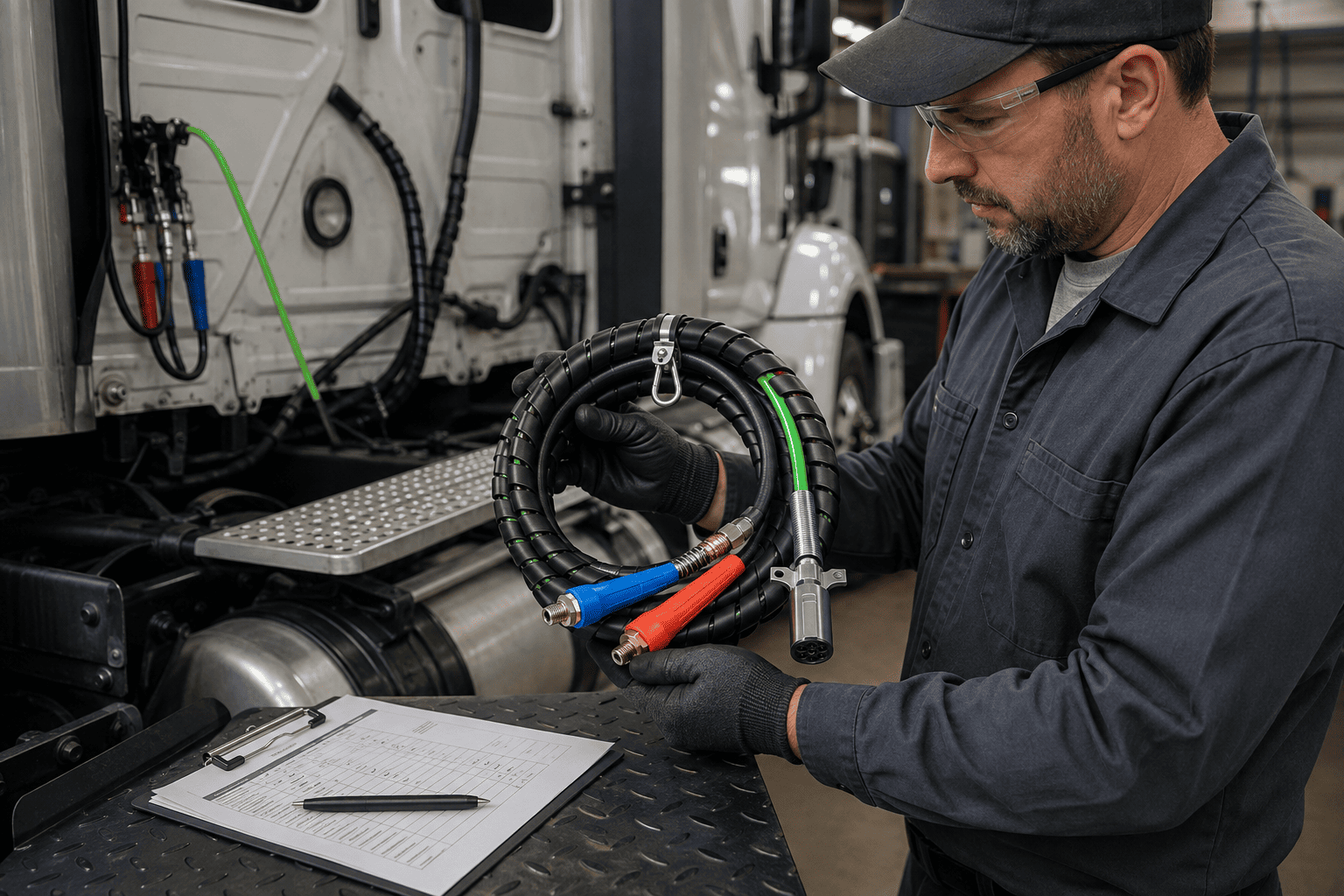
But many buyers stop at price and “universal fit” claims. Below, I’ll walk through the overlooked details that separate a procurement risk from a secure, long-term supply—details I’ve learned from years of customer specification confirmation, factory inspection, and after-sales feedback.
What Does “Universal” Really Mean for a 3-in-1 Air Power Line?
The first question I hear from new buyers is often the wrong one: “Is this 3-in-1 line universal?” That mindset leads to bulk orders that end up incompatible with the trailers they’re meant to serve. Universal fit doesn’t exist in heavy-duty air brake systems.1 Every truck model and trailer configuration has subtle differences in gladhand connectors, electrical pinout, hose length, and spring guard geometry.
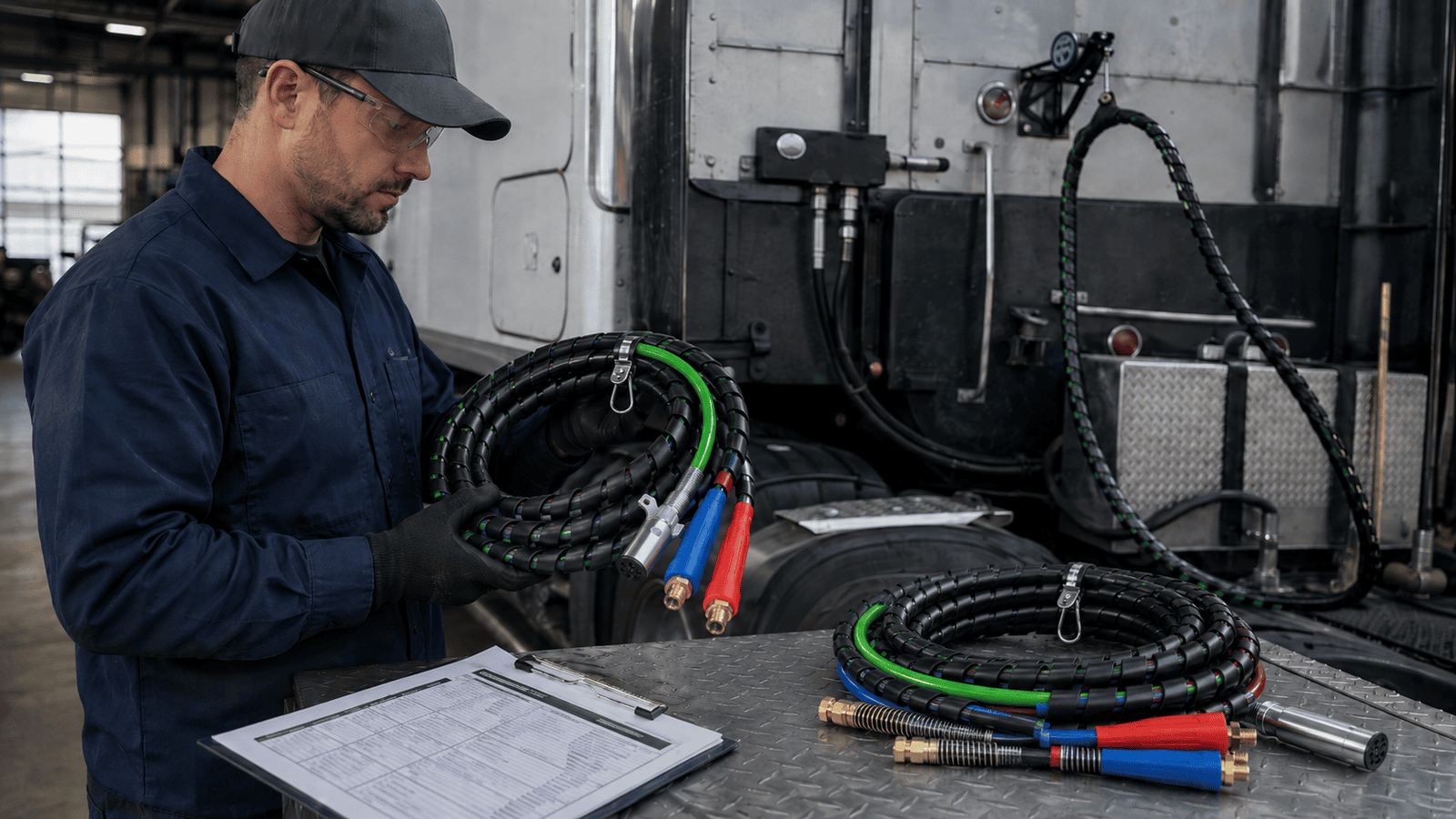
A reliable 3-in-1 air power line is not universal; it is application-specific. You must confirm the gladhand type (red emergency, blue service), the 7-pin electrical connector pattern (SAE J560 or ISO), the coiled air hose length (typically 12ft to 15ft extended), the spring guard design, and the color coding. A mismatch as small as 2 inches in length or a different gladhand seal profile can cause coupling failure or air leaks under vibration.
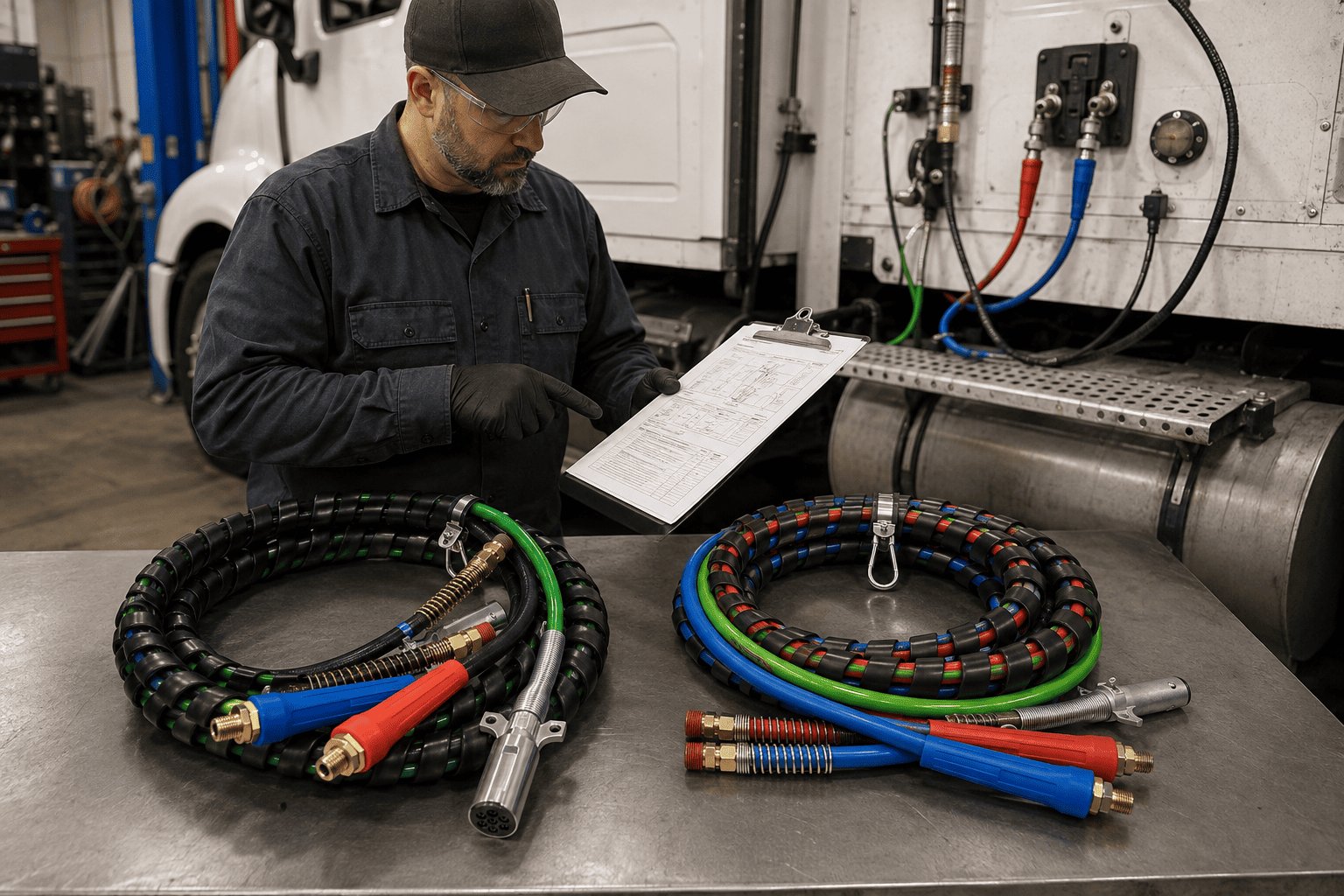
The Hidden Trap of One-Size-Fits-All Thinking
I recall a distributor who ordered 500 units based on a single photo. The spring guards were too short for their trailers’ coupling range, and the gladhand rubber seals were a different hardness. The result? 30% of the units were returned within three months. The “universal” spec sheet had missed the fine print.
When you evaluate a 3-in-1 air power line, the specification sheet must be your first filter. Here’s what I’ve seen even experienced procurement managers overlook:
- Gladhand connector type and polarity: Red gladhands (emergency line) and blue ones (service line) have slightly different internal dimensions. Some fleets also use brass gladhands for colder climates, which require matching nipple profiles.
- Electrical cable pinout: A 7-pin SAE J560 connector is standard in North America2, but the wiring sequence for ABS power and ground can vary by trailer manufacturer. Always request a pinout diagram.
- Coiled hose length and diameter: The working length (typically 12 ft) and the hose outer diameter (often 3/8” or 1/2”) must match the trailer’s coupling range. A hose that’s too short will stretch and crack; one that’s too long will drag.3
- Spring guard type: Rubber-coated steel springs, stainless steel springs, and plastic spiral guards each offer different levels of abrasion and cold-weather resistance. The wrong choice leads to premature spring failure.
The takeaway: Before you ask for a price, ask for the full dimensional drawing and connector codes. A reliable supplier will ask for your truck model, trailer type, and operating environment—not just a part number.
Why Do 3-in-1 Air Power Lines That Look Identical Perform Differently?
You can hold two 3-in-1 air power lines in your hands, and they might look nearly identical. But the difference in fleet downtime comes down to what’s inside. In our factory, we’ve dissected dozens of market samples, and the gap between a high-quality assembly and a low-cost alternative is stark.
The difference lies in hidden materials: oxygen-free copper conductors vs. copper-clad aluminum, oil-resistant rubber jacket vs. standard PVC, precision-machined brass fittings vs. cast zinc, and stainless steel springs vs. painted steel. These materials determine resistance to corrosion, cold cracking, abrasion, and repeated coupling cycles, which directly affect fleet downtime and maintenance costs.
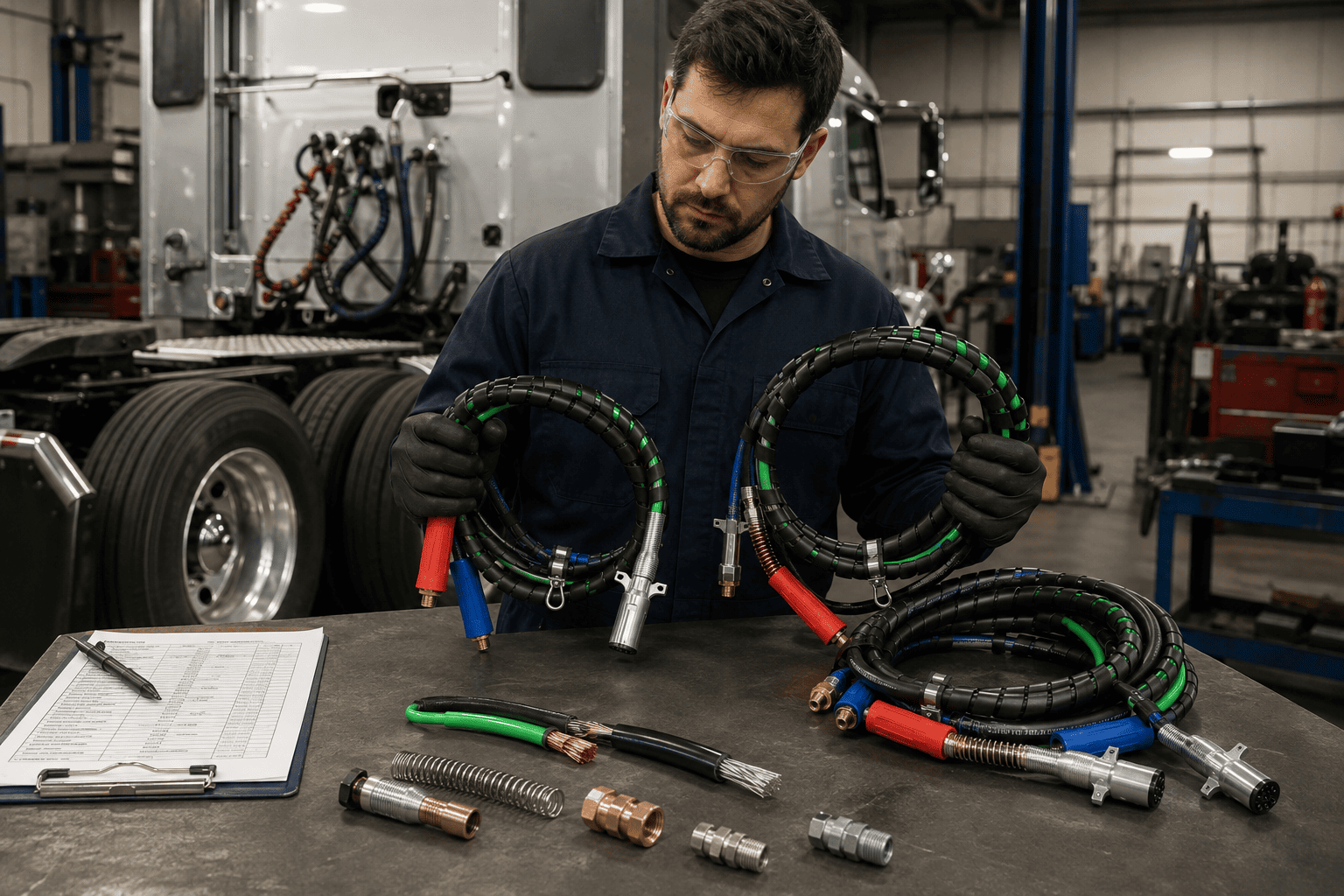
The Material Decisions That Matter Most
When I talk to fleet maintenance managers, they often don’t realize that the electrical cable inside a 3-in-1 line is the most common failure point. Here’s what to inspect:
Electrical conductor quality:
- Oxygen-free copper (OFC) strands provide consistent conductivity, flexibility, and resistance to corrosion. Copper-clad aluminum (CCA) conductors are cheaper but oxidize faster, causing intermittent ABS warning lights.4 I’ve seen CCA conductors fail inside the jacket within a year of road salt exposure.
- Strand count and gauge: A reliable 3-in-1 line uses at least 7-strand copper conductors for the ABS and power wires, with sufficient gauge (typically 12 AWG for power, 14 AWG for signal) to handle current without heating.
Rubber jacket durability:
- The outer jacket of the air hose and the electrical cable must resist diesel, oil, UV light, and extreme temperatures. We use a synthetic rubber compound that withstands -50°C to +120°C. Cheap PVC jackets become brittle in cold climates and crack.5
- Abrasion resistance: The jacket should be reinforced with a braided layer or use a high-tensile compound. When you rub a sample against a rough surface, it should not scuff easily.
Spring protection:
- A stainless steel spring guard resists rust and keeps the coil shape even after thousands of coupling cycles. Painted steel springs can rust through, losing their spring force and leaving the hoses kinked.
- Spring wire diameter and coating: The thicker the spring wire, the better the protection. Look for a minimum of 2.5mm wire diameter with a durable coating.
Connector and fitting quality:
- Brass gladhands and fittings machined from solid brass bar stock offer better sealing and corrosion resistance than cast zinc or plastic composites.6 The gladhand rubber seal must be a high-quality compound that doesn’t harden over time.
- Sealing surface finish: Precision-machined surfaces ensure an airtight seal every time. A rough finish can cause slow leaks that are hard to detect.
Coupling durability:
- The electrical plug must withstand repeated insertion and removal without loosening. Check for corrosion-resistant terminals and a robust locking mechanism.
A simple way to screen a supplier: ask for a cutaway sample. If they can’t show you the conductor material, the rubber compound, or the spring wire under magnification, the product is likely built to a price, not a performance standard.
How Can You Verify a 3-in-1 Air Power Line’s Real Reliability Before Buying?
A product photo and a promise of “DOT approved” are not enough. I’ve learned that the most reliable 3-in-1 air power lines come with a paper trail of testing evidence, not just marketing claims. When you’re importing thousands of units, a single undocumented batch can cause legal complications and inventory write-offs.
Ask for documented evidence: DOT certification numbers, ISO 9001 quality management certificates, and specific test reports—air tightness at 2.5MPa for 5 minutes, tensile strength ≥150% of the design load, temperature cycling from -50°C to +120°C, and burst pressure ≥4× working pressure.7 A supplier that performs 100% factory inspection on these critical items and provides traceability records from raw material to finished assembly lowers your procurement risk.
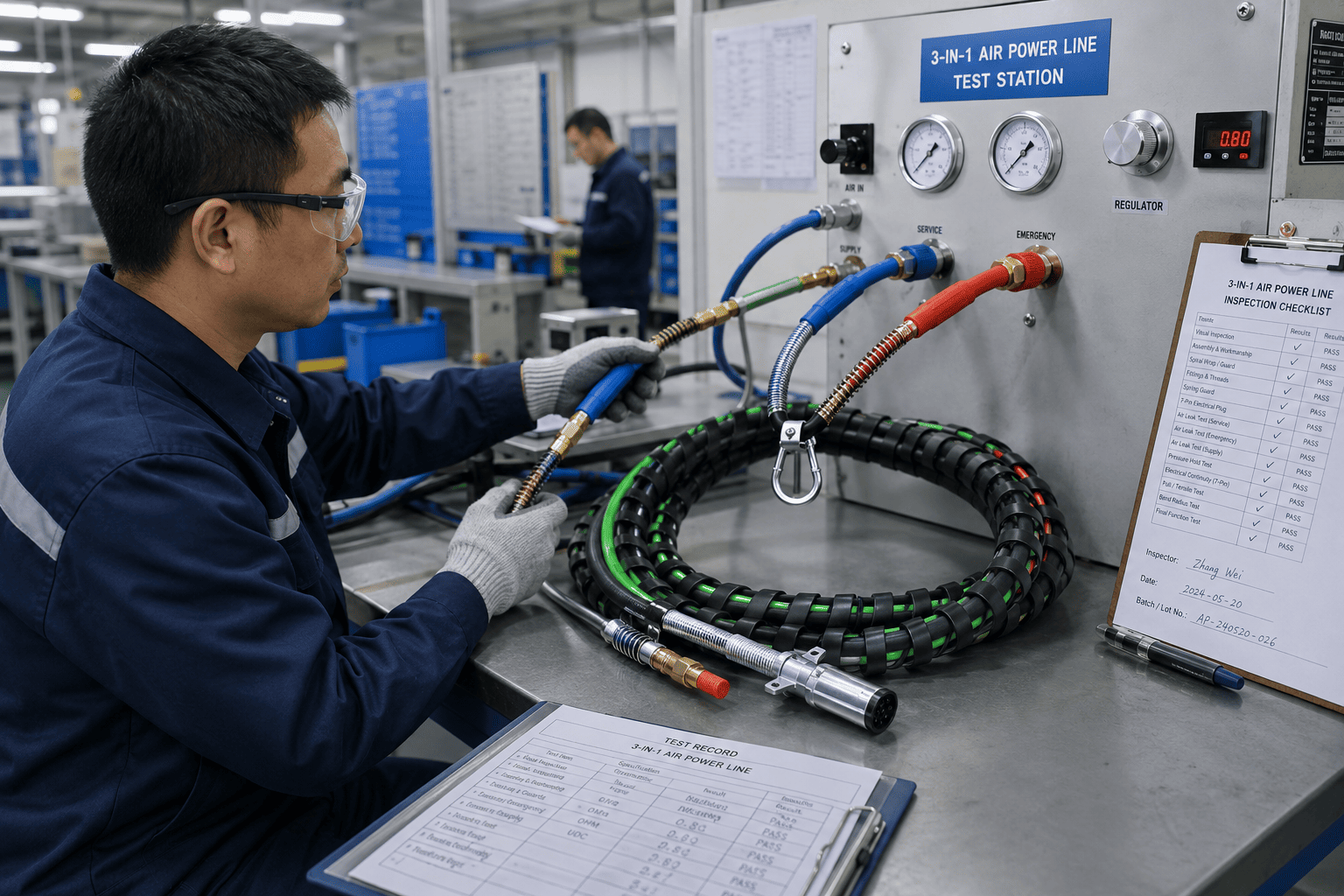
The Tests That Prove a 3-in-1 Line Won’t Fail
In our factory, we don’t just test a sample; we test every single assembly before it ships. Here’s what you should look for and why each test matters:
| Test Parameter | What It Checks | Why It Matters for Your Fleet |
|---|---|---|
| Air tightness (2.5MPa, 5 min) | Leakage across the entire air circuit, including hose, fittings, gladhand seals | A slow leak can cause brake drag or emergency brake application at highway speeds.8 |
| Tensile strength (≥150% design load) | The coiled assembly’s ability to withstand pulling force without separation | In real use, trailers yank on the line; weak crimps or poor hose bonding cause sudden failure. |
| Temperature cycling (-50°C to +120°C) | Material flexibility and seal integrity under extreme cold and engine heat | Rubber that hardens in winter can crack; seals that soften in summer can blow out. |
| Burst pressure (≥4× working pressure) | The hose’s maximum pressure before catastrophic rupture | A burst hose can cause complete loss of trailer braking; this is a safety-critical test.9 |
| Electrical continuity and insulation resistance | Conductor integrity and isolation between circuits | Prevents ABS faults, short circuits, and intermittent lighting issues. |
A reliable supplier will provide these test reports for each production batch, not just a one-time third-party certification. Ask for the actual inspection checklists and the pass/fail criteria. If they can’t produce them, assume the tests aren’t being done.
The Paperwork That Protects Your Business
Beyond the physical tests, the documentation you receive is your shield against import and sales risks:
- DOT certification: This indicates compliance with U.S. Department of Transportation safety standards. But always verify that the certification is current and covers the specific product codes you’re importing. Ask for the DOT registration number and cross-check it on the NHTSA website.
- FMVSS and SAE J2394 compliance: These standards define the performance requirements for air brake hose and cable assemblies. A supplier should be able to state which specific clauses their product meets.
- ISO 9001:2015 certificate: This shows the factory has a quality management system, but it doesn’t guarantee product quality by itself. Look for evidence that the system is actively used: inspection records, non-conformance reports, and traceability logs.
- Traceability system: In 2022, we launched an intelligent product traceability system that links every assembled 3-in-1 line to its raw material batches, production date, and inspection results. If a batch issue arises, we can isolate it immediately. Ask your supplier how they ensure traceability from raw material to finished product.
From my experience, the most diligent importers request a sample with a corresponding inspection report, then have the sample independently tested. That’s a small investment that can save you from a costly recall.
What Are the Hidden Business Risks of a Poorly Chosen 3-in-1 Air Power Line?
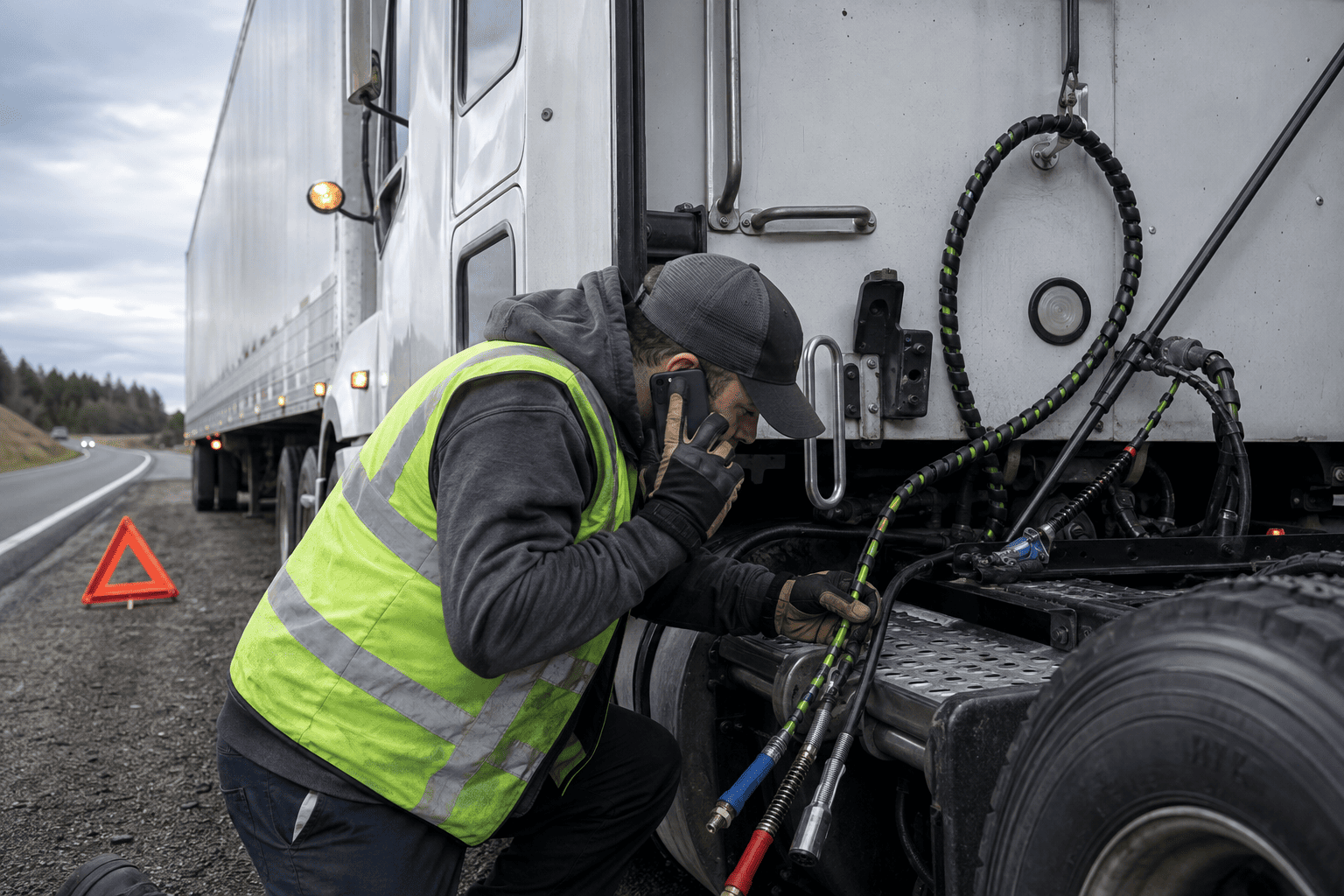
Price is visible; risk is not. I’ve seen distributors lose a key fleet account because a low-cost 3-in-1 air power line caused a roadside failure. The initial savings disappeared in downtime, warranty claims, and damaged reputation.
The real cost of a poor 3-in-1 air power line choice is not the purchase price; it’s the compounding risk of wrong specifications, early field failures, import compliance issues, and high warranty claims. A single mismatched line can cause a trailer brake failure, leading to safety incidents, DOT fines, and lost distributor trust. Weak batch consistency means every shipment becomes a gamble.
Where the Losses Hide
When a procurement decision goes wrong, the costs rarely appear on the invoice. Here’s where they accumulate:
- Wrong specification orders: I recall a customer who ordered 1,000 units with a standard 7-pin connector, only to discover their trailers used a different pin arrangement for the ABS system. The entire shipment was unusable. The cost of rework or return freight wiped out any price advantage.
- Downtime and emergency repairs: A failed 3-in-1 line means a tractor-trailer is out of service. The average cost of truck downtime in North America is over $200 per hour.10 If a fleet has ten trucks and five experience a hose failure in a month, the operational loss dwarfs the part cost.
- Compliance and liability exposure: Using a non-compliant air brake component can lead to a failed DOT roadside inspection, fines, and even an out-of-service order.11 If a failure contributes to an accident, liability can escalate. Buyers must ensure the product is properly certified and that the documentation is kept on file.
- Warranty claims and after-sales burden: Distributors who sell unreliable 3-in-1 lines often face a wave of warranty returns. Each return involves shipping, inspection, replacement, and customer service time. For a typical 20% margin, a 5% return rate can erase profitability. Worse, the distributor’s reputation with fleets is damaged, and future orders are lost.
- Batch inconsistency risk: I’ve seen suppliers send a perfect first sample, then cut corners on the next production run. The second batch uses a slightly different rubber compound, thinner spring wire, or a cheaper seal material. Without rigorous incoming inspection, the distributor doesn’t know until the field failures start. That’s why batch traceability and 100% testing are not optional—they are risk management.
The lesson I share with every new buyer: evaluate the total cost of ownership, not the unit price. A reliable 3-in-1 air power line might cost a few dollars more per unit, but it eliminates the hidden costs that can sink a distribution business.
How Do You Evaluate a Supplier’s Capability for Consistent 3-in-1 Air Power Line Quality?
A single good sample doesn’t prove a supplier can deliver thousands of consistent assemblies. When I talk to procurement managers who are qualifying a new factory, I tell them to look for integrated manufacturing control, not just final product checks.
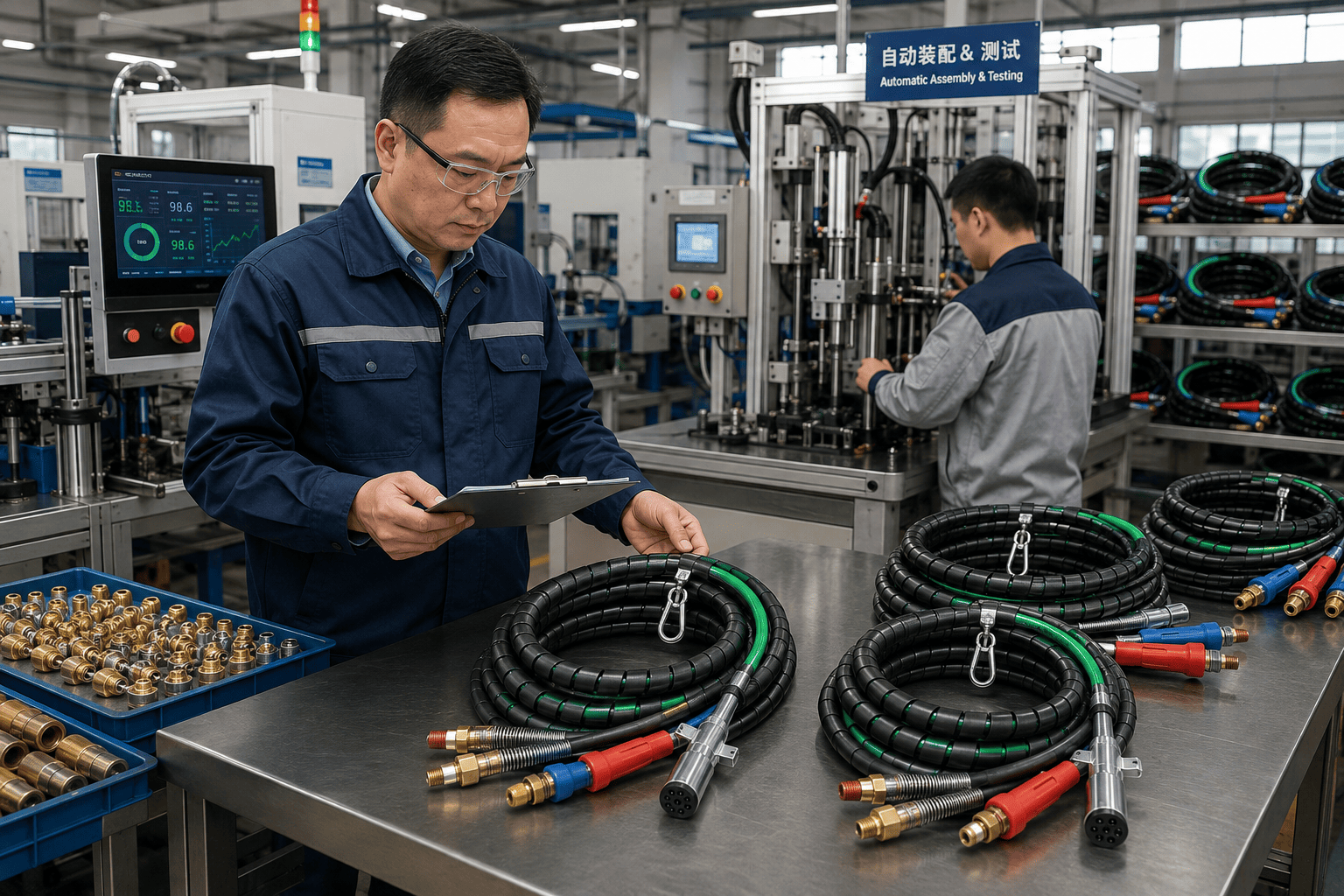
Look beyond the product sample. A capable supplier must have in-house mold development, CNC machining, automated assembly, and 100% inspection on critical parameters. Verify their production capacity (10+ million sets/year), quality system (ISO 9001), and after-sales support. Ask for traceability systems from raw material to finished product, and request a factory audit report if possible.
What a Reliable 3-in-1 Air Power Line Factory Looks Like
Having overseen our own production base in Ningbo, I can share what true manufacturing control means. When you evaluate a supplier, ask these questions:
- Do they control the entire process? A factory that only assembles purchased components has limited control over quality. A reliable supplier should have in-house mold development for gladhands and seals, CNC machining for brass fittings, and automated assembly lines. This ensures that dimensional tolerances, material feeds, and joining processes are maintained. In our factory, we have 30 CNC lathes and dedicated injection molding equipment, allowing us to control every critical dimension from the start.
- What is their production capacity and how do they manage batch consistency? A supplier with a capacity of 10+ million sets per year, like ours, demonstrates the ability to handle large orders. But capacity alone isn’t enough. Ask how they maintain consistency across batches. The answer should include documented work instructions, calibrated tooling, and a raw material incoming inspection program. For example, we inspect every batch of copper wire for conductivity and every rubber compound for hardness and tensile properties before it enters production.
- What does their inspection regimen look like? The most important test is 100% functional testing on every unit. We subject each assembled 3-in-1 line to an automated air tightness test at 2.5MPa for 5 minutes. Any unit that leaks is rejected. We also perform random tensile and burst tests on each production batch. Ask for a sample inspection report format; it should show the measured values, not just “pass/fail.”
- Do they have a traceability system? A reliable supplier can trace a finished product back to the raw material batch, the production date, the machine operator, and the inspection results. In 2022, we implemented an intelligent traceability system that assigns a unique code to each assembly. If a quality issue ever arises, we can pinpoint the scope of the problem in minutes. This level of transparency is rare but essential for risk-averse buyers.
- What after-sales support do they provide? A capable supplier will have a technical support team that can handle specification questions, provide installation guidance, and manage warranty claims. They should be able to produce a certificate of conformance for each shipment and support you with documentation for your own customers.
I’ve seen too many importers rely on a single factory visit and a handshake. A reliable 3-in-1 air power line supply chain is built on evidence, not relationships. The supplier who can show you the mold shop, the CNC floor, the automated test log, and the traceability system is the one that will protect your business.
Frequently Asked Questions
Can I use a 3-in-1 air power line with any semi truck?
No. Compatibility depends on gladhand type, electrical connector pinout, coiled hose length, and spring guard design. Always verify the assembly against your truck and trailer specifications before ordering.
How often should a 3-in-1 air power line be replaced?
Replacement intervals vary by usage and environment, but inspect for cracks, corrosion, or air leaks every 6 months. Replace the line immediately if the rubber jacket shows deep abrasion, the spring guard is rusted through, or the electrical connector is loose.
What does DOT certification mean for a 3-in-1 line?
DOT certification indicates that the product meets U.S. Department of Transportation safety standards for air brake systems. However, buyers should verify the specific FMVSS and SAE J2394 clauses met and check the current validity of the certification with the supplier.
Why does my 3-in-1 line cause ABS warning lights?
Intermittent ABS faults are often caused by poor electrical conductivity due to low-quality conductors (like copper-clad aluminum) or corroded terminals. Ensure the cable uses oxygen-free copper conductors and that the electrical plug is sealed against moisture.
How can I spot a low-quality 3-in-1 air power line before buying?
Check for thin, easily scuffed rubber jacket, painted steel springs that show rust, non-brass gladhand fittings, and lack of factory test documentation. Request a sample and perform a simple air leak test by pressurizing the line and submerging it in water.
Conclusion
Choosing a reliable 3-in-1 air power line for semi trucks is a decision that echoes through your fleet’s uptime, your compliance risk, and your bottom line. The assembly that looks good on a shelf can fail silently if the conductor is CCA, the rubber jacket isn’t oil-resistant, or the fit isn’t precise. The only way to control that risk is to verify material integrity, documented testing, and supplier capability before you place a bulk order. Don’t let a universal-fit claim or a low price distract you from the evidence that matters: DOT certification, 100% factory inspection records, and batch traceability. When you get those right, you’re not just buying a part—you’re securing a supply chain that won’t let you down.
If you’re sourcing 3-in-1 air power lines and want to discuss your specifications, test documentation, or a sample with full inspection reports, our team is ready to help you make an informed choice.
"Interpretation ID: 10-001831 106", https://www.nhtsa.gov/interpretations/10-001831-106. Heavy-vehicle brake-hose and tractor-trailer connector standards identify distinct interface, labeling, and performance requirements, supporting the view that compatibility depends on specified components rather than appearance alone. Evidence role: general_support; source type: institution. Supports: Standards and inspection references should support that brake hose assemblies, gladhands, and tractor-trailer electrical connectors are governed by specific interface requirements rather than a single universal fit.. Scope note: This would provide contextual support for application-specific selection, but it would not prove that every product marketed as universal is incompatible. ↩
"Interpretation ID: nht95-4.81", https://www.nhtsa.gov/interpretations/nht95-481. SAE J560 defines the seven-conductor electrical connector used for truck-tractor and trailer electrical interconnection, supporting the identification of SAE J560 as the relevant North American connector standard. Evidence role: definition; source type: institution. Supports: A standards source should define SAE J560 as the seven-conductor electrical connector standard used for truck tractor and trailer interconnection.. Scope note: The standard defines the connector interface but does not establish that every trailer manufacturer wires every auxiliary circuit identically. ↩
"5.1.1 Brake Systems (Part 393 Subpart C) - CSA", https://csa.fmcsa.dot.gov/safetyplanner/MyFiles/SubSections.aspx?ch=22&sec=64&sub=130. Federal and roadside inspection guidance treats damaged, kinked, chafed, or improperly routed brake hoses as safety-relevant defects, supporting the need for hose length and routing that avoid strain and road contact. Evidence role: mechanism; source type: government. Supports: A government or inspection source should support that brake hoses can become safety defects when stretched, kinked, chafed, dragged, or otherwise damaged.. Scope note: Such guidance supports the failure mechanism generally but may not specify an exact acceptable length for each tractor-trailer geometry. ↩
"CCA Wire Conductivity vs Pure Copper: 60–70% IACS Explained", https://www.litongcable.com/CCA-Wire-Conductivity-Explained-How-It-Compares-to-Pure-Copper. Materials studies on copper-clad aluminum conductors report conductivity and corrosion behavior that differs from solid copper, while vehicle electrical diagnostics associate increased circuit resistance and connector corrosion with intermittent ABS faults. Evidence role: mechanism; source type: paper. Supports: A materials or vehicle-electrical reliability source should support that aluminum-containing conductors have different corrosion and conductivity behavior than copper and that increased resistance or poor connections can affect ABS circuits.. Scope note: This would support the mechanism contextually; it would not by itself prove that a specific 3-in-1 line with CCA conductors will fail within a particular service interval. ↩
"Low Temperature Properties of Polymers", https://www.appstate.edu/~clementsjs/polymerproperties/plastics_low_temp.pdf. Polymer materials literature describes reduced ductility and increased brittleness of PVC at low temperatures, particularly where formulation and plasticizer content are unsuitable for cold-service flexibility. Evidence role: mechanism; source type: paper. Supports: A polymer materials source should support that PVC formulations lose flexibility and can become brittle at low temperatures, depending on plasticizer content and formulation.. Scope note: The evidence would support PVC behavior generally; actual jacket performance depends on the specific PVC compound and test temperature. ↩
"What brass alloys are most corrosion-resistant for plumbing ...", https://www.newaydiecast.com/services/copper-die-casting/faq-what-brass-alloys-are-most-corrosion-resistant-for-plumbing-fittings. Materials references report that brass alloys are commonly used for fittings because of their corrosion resistance and machinability, and sealing performance depends on controlled dimensions and surface finish. Evidence role: general_support; source type: research. Supports: A materials reference should support brass corrosion resistance and the importance of surface finish and dimensional control in sealing fittings.. Scope note: This supports the material rationale generally but does not prove that every machined brass gladhand outperforms every cast zinc or composite design. ↩
"49 CFR 571.106 -- Standard No. 106; Brake hoses.", https://www.ecfr.gov/current/title-49/subtitle-B/chapter-V/part-571/subpart-B/section-571.106. Federal brake-hose regulations and related SAE standards establish performance, labeling, and pressure-test requirements for brake hose assemblies, supporting the use of documented compliance and test reports in procurement. Evidence role: general_support; source type: government. Supports: Regulatory and standards sources should support the need for documented compliance and performance testing of brake hose assemblies, including pressure and identification requirements.. Scope note: The cited standards may not match every numerical threshold stated in the article unless the source specifically includes those test values. ↩
"Air Brake Systems", https://www.fmcsa.dot.gov/sites/fmcsa.dot.gov/files/docs/brake_safety_systems_02-14.pdf. Government commercial-driver air-brake materials explain that air-pressure loss can impair brake operation and that spring brakes apply when system pressure falls below safe levels. Evidence role: mechanism; source type: government. Supports: A government air-brake training or safety source should explain that loss of air pressure can affect service braking and cause spring brakes to apply.. Scope note: This supports the mechanism of pressure-loss consequences but not the precise likelihood of brake drag or emergency application for every slow leak. ↩
"5.1.1 Brake Systems (Part 393 Subpart C) - CSA", https://csa.fmcsa.dot.gov/safetyplanner/MyFiles/SubSections.aspx?ch=22&sec=64&sub=130. Commercial motor vehicle brake regulations and inspection criteria identify ruptured or leaking brake hoses as safety defects because air loss can compromise trailer brake operation. Evidence role: mechanism; source type: government. Supports: A government or inspection source should support that brake hose rupture can cause rapid air loss and serious brake-system malfunction.. Scope note: The exact braking outcome depends on system design, redundancy, and whether emergency spring brakes apply after pressure loss. ↩
"Public Works | Fleet Software", https://www.mtas.tennessee.edu/reference/fleet-software. Transportation cost research estimating commercial truck downtime or operating interruption costs above $200 per hour would support the article’s quantitative benchmark for downtime exposure. Evidence role: statistic; source type: research. Supports: A transportation research or fleet operations study should provide an estimated hourly cost of commercial truck downtime or operating interruption.. Scope note: Downtime estimates vary by fleet type, freight segment, driver cost, lost revenue assumptions, and whether the study measures operating cost or full business interruption cost. ↩
"Common Violations", https://csa.fmcsa.dot.gov/safetyplanner/documents/Forms/Common%20Violations_508.pdf. Federal motor carrier enforcement rules and roadside inspection criteria classify certain brake-system and brake-hose defects as violations that may result in citations or out-of-service orders. Evidence role: general_support; source type: government. Supports: A government enforcement or inspection source should support that brake-system defects, including brake hose defects, can be cited during roadside inspections and can trigger out-of-service action.. Scope note: Fine amounts and enforcement outcomes vary by jurisdiction, defect severity, and inspection circumstances. ↩