A DOT brass fittings manufacturer can make your procurement easier, or it can create costly complaints when bulk orders do not match samples. The problem is that many fittings look acceptable at first glance. The risk grows after repeat orders. The solution is to evaluate compliance, process control, and supply reliability before price.
A reliable DOT brass fittings manufacturer should provide clear DOT/SAE/FMVSS-related documentation1, stable batch quality, material and inspection records, air-tightness and pressure testing evidence, and practical support for mixed orders, packaging, and cross-border delivery. Buyers should treat supplier selection as risk control, not only as unit-price comparison.
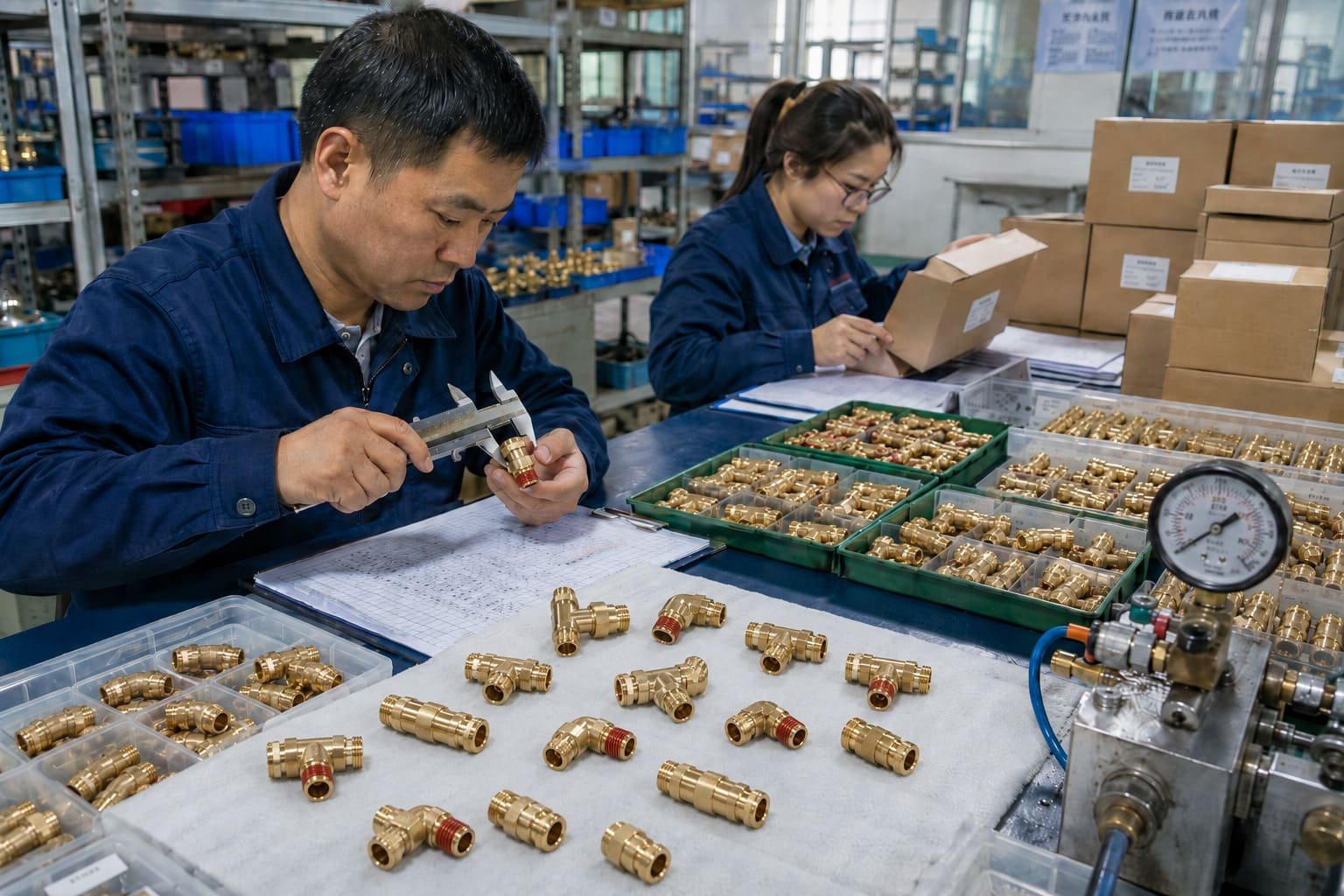
I have seen many buyers start with one simple question: “Can you send samples?” Samples matter, but they are only the first layer. The better question is whether the supplier can keep the same performance, packaging, markings, and delivery rhythm across many bulk shipments.
Why Should I Treat a DOT Brass Fittings Manufacturer as a Risk-Control Partner?
A DOT brass fittings manufacturer affects more than your purchase cost. A weak supplier can create leakage claims, wrong-fit complaints, delayed inventory replenishment, and customer trust problems. I always advise buyers to look beyond the first quotation because a cheap fitting becomes expensive when it fails in the field.
A reliable manufacturer should reduce procurement risk through documented compliance scope, stable production control, batch traceability2, and consistent communication. Buyers should check whether the manufacturer can support repeatable bulk quality, not only whether the first samples look good or the quoted price is attractive.
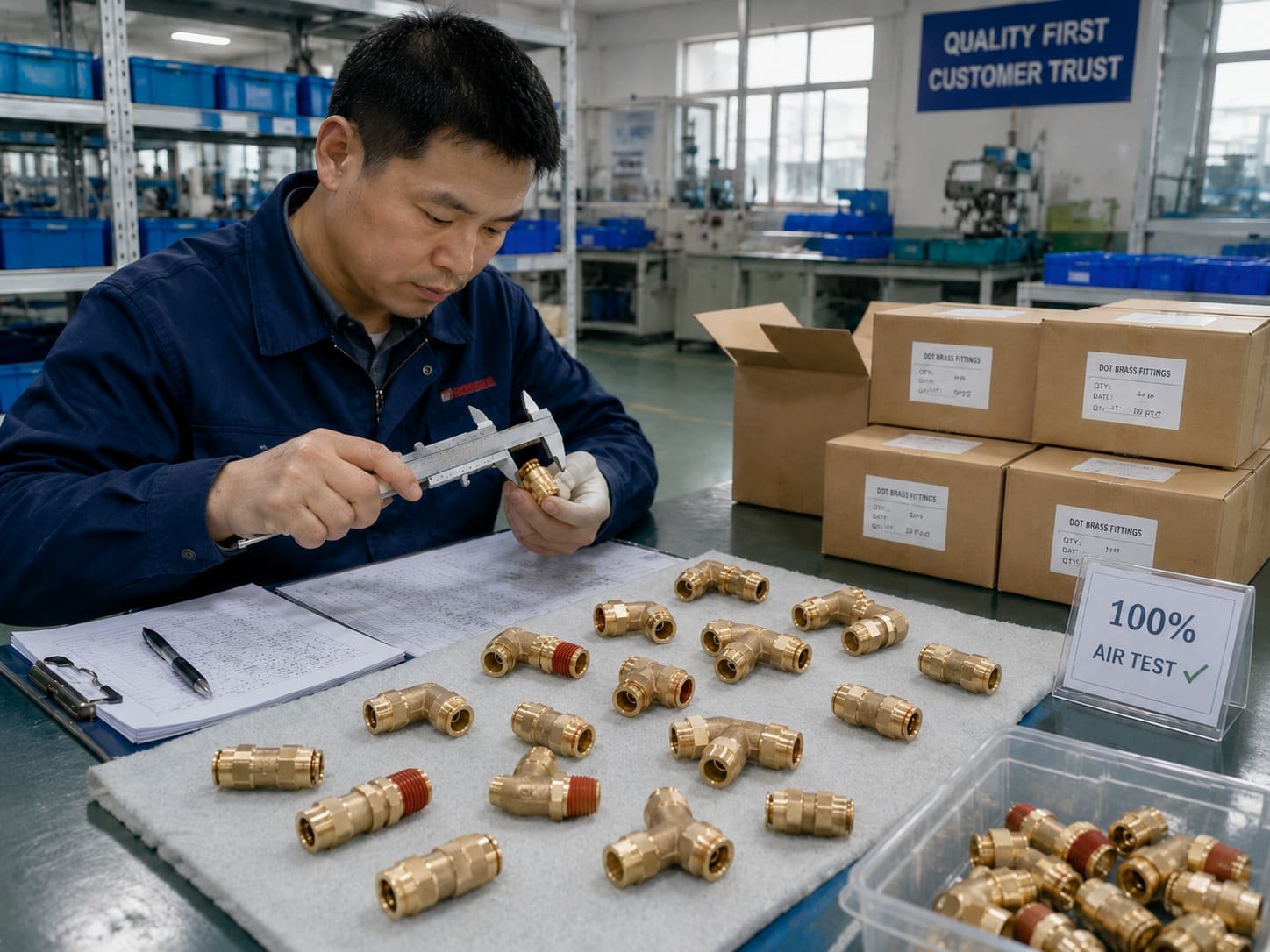
Price Is Only One Part of the Real Cost
In commercial vehicle aftermarket sourcing, the lowest unit price can look attractive on a spreadsheet. However, I usually ask buyers to calculate the full cost of supplier risk3. That cost includes:
- Returned products from repair shops or fleets
- Extra labor for sorting defective batches
- Delayed sales because inventory cannot be shipped
- Customer complaints about air leakage or thread mismatch
- Emergency air freight when replenishment is late
- Brand damage for distributors and parts stores
For heavy-duty truck parts distributors, these hidden costs often matter more than a few cents saved on each brass fitting.
Samples Do Not Prove Bulk Stability4
A sample order can show dimensions, appearance, thread quality, and basic packaging. It cannot fully prove that the supplier controls bulk production. I have seen buyers receive good samples, then struggle with unstable repeat orders because the manufacturer did not control raw material batches or in-process inspection.
A stronger evaluation should include these questions:
- Does the supplier inspect incoming brass or copper materials?
- Does the supplier keep batch records?
- Does the supplier test air tightness and pressure resistance?
- Does the supplier have a final inspection standard before warehousing?
- Does the supplier understand North American and South American truck aftermarket demand?
At BOERAY TRUCK PARTS, we manufacture and supply heavy-duty truck aftermarket parts from Ningbo, and our experience has taught me that consistency is the real test. A buyer may accept one good carton, but a distributor needs hundreds or thousands of pieces that perform the same way.
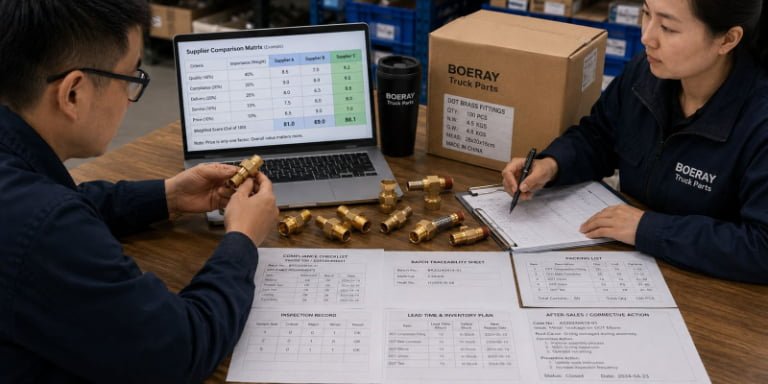
A Practical Risk-Control View
I like to use this simple comparison when I discuss DOT brass fittings procurement with customers:
| Evaluation Area | Weak Signal | Strong Signal |
|---|---|---|
| Compliance | “We have DOT” as a short claim | Documents showing scope, standard, and product relevance |
| Quality | Good surface finish only | Incoming inspection, process sampling, and final checks |
| Testing | Verbal promise | Air-tightness, pressure, and dimensional test records |
| Bulk consistency | Good sample only | Batch traceability and repeated order stability |
| Commercial fit | MOQ is fixed and rigid | Flexible MOQ, mixed orders, and packaging support |
| Communication | Slow replies after payment | Clear updates before, during, and after production |
A reliable DOT brass fittings manufacturer should help you protect your customers, not simply ship boxes. That mindset changes the whole sourcing process.
What DOT, SAE, and FMVSS Documents Should Buyers Verify?
DOT-related wording can be useful, but it should never be treated as a simple marketing label.5 Buyers can face risk when documents are unclear, expired, or unrelated to the exact product being purchased. I always recommend asking what the document covers and where the compliance boundary begins and ends.
Buyers should verify DOT, SAE, and FMVSS-related documents by checking the product scope, applicable standard, test method, issuing body, document date, and part numbers or product families covered. A reliable supplier should explain which fittings the documents apply to and provide supporting records when needed.
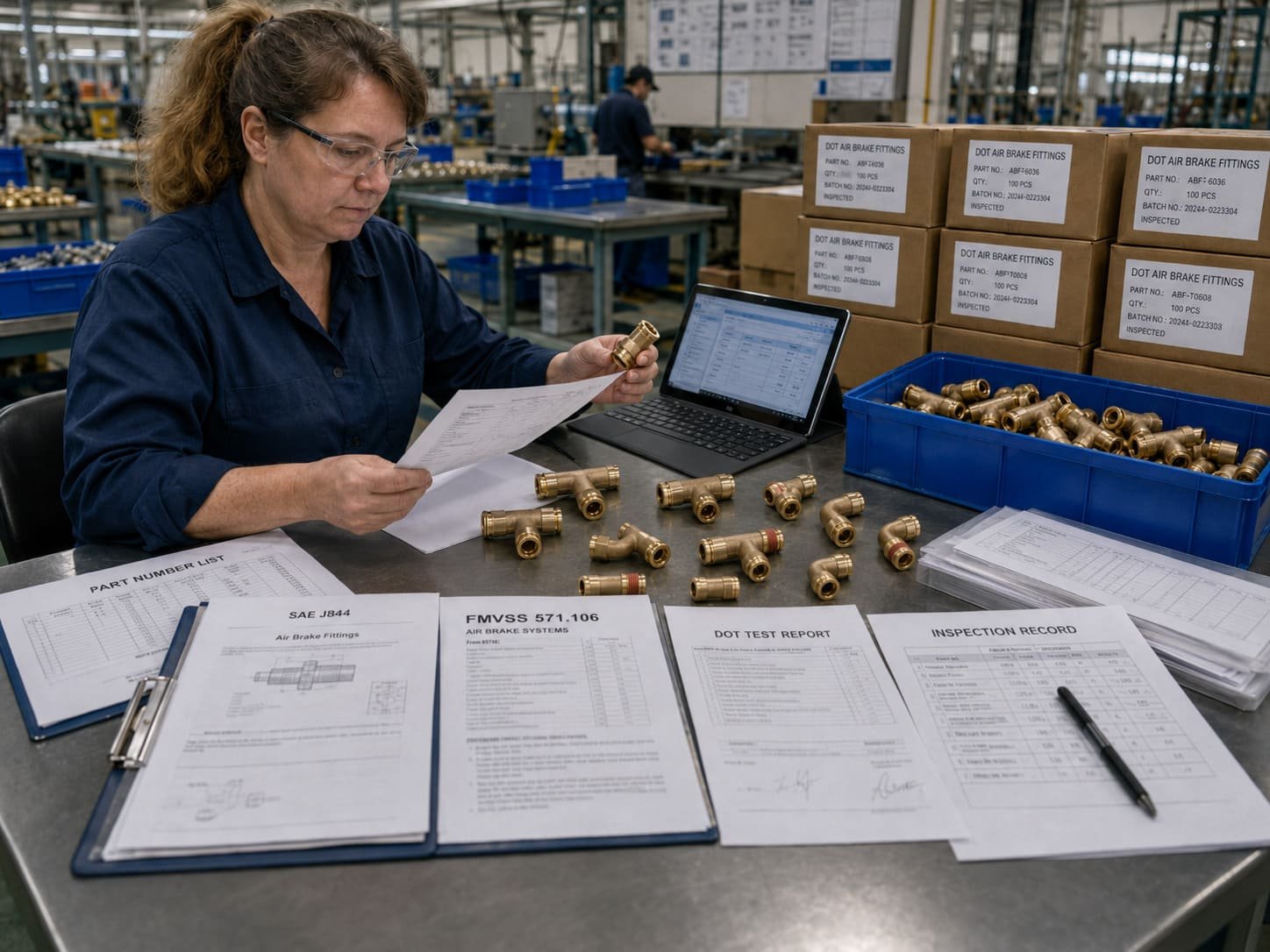
“DOT” Needs Context
In the commercial vehicle parts market, “DOT” often appears in product descriptions for air brake fittings, air line components, tubing, and related pneumatic parts. However, buyers should not stop at the label. A fitting may be described as DOT type, DOT-compliant, or suitable for DOT air brake applications, but those words need evidence.
I suggest buyers ask for:
- Relevant DOT-related compliance information
- SAE standard references6, when applicable
- FMVSS-related documentation, when applicable
- Product family or part number coverage
- Test reports or inspection records linked to the product
- Material certificates or batch compliance documents
- Supplier quality management certificates, such as ISO 9001
This approach does not mean that every buyer must become a regulatory expert. It means the buyer should confirm that the supplier understands compliance boundaries and can support the claim with records.
Check the Scope Before You Trust the Document
A document can look official and still fail to cover your actual part. I have seen buyers focus on the certificate title while missing the covered product list. That creates a risk when the purchased brass push-in fitting, compression fitting, or air brake connector is outside the document scope7.
A buyer should review these points:
| Document Item | Why It Matters |
|---|---|
| Product description | It shows whether the document applies to your fitting type |
| Part number or size range | It helps confirm coverage for your ordered SKUs |
| Standard reference | It connects the product to recognized requirements |
| Date and validity | It reduces the risk of outdated evidence |
| Issuer or testing source | It helps you judge credibility |
| Test conditions | It shows the limits of the result |
If a supplier cannot explain the document clearly, that is not always proof of bad quality. However, it is a reason to ask more questions before placing a bulk order.
Compliance Documents Are Not a Lifetime Guarantee
A certificate or test report does not guarantee that every future shipment will be perfect. It is one part of the evaluation. Real reliability comes when compliance documents are supported by ongoing process control8.
For example, a manufacturer may have test results for a certain brass fitting series. The buyer should still ask how production is controlled every month. The supplier should be able to explain:
- How raw materials are checked
- How dimensions are measured during production
- How air-tightness is tested
- How defective parts are isolated
- How finished goods are sampled before warehousing
- How batch records are archived
In our production and customer communication experience, buyers from North America often pay close attention to documentation because their customers expect stable standards. South American buyers often ask similar questions, especially when they manage mixed containers and multiple aftermarket SKUs. In both cases, the same rule applies: a reliable DOT brass fittings manufacturer should make compliance traceable and understandable.
How Can a DOT Brass Fittings Manufacturer Prove Bulk Quality Consistency?
A DOT brass fittings manufacturer can impress you with clean samples, but bulk consistency depends on repeatable production control. This is where many sourcing mistakes happen. Buyers may check the first shipment carefully and then assume later batches will stay the same without asking how the supplier controls variation.
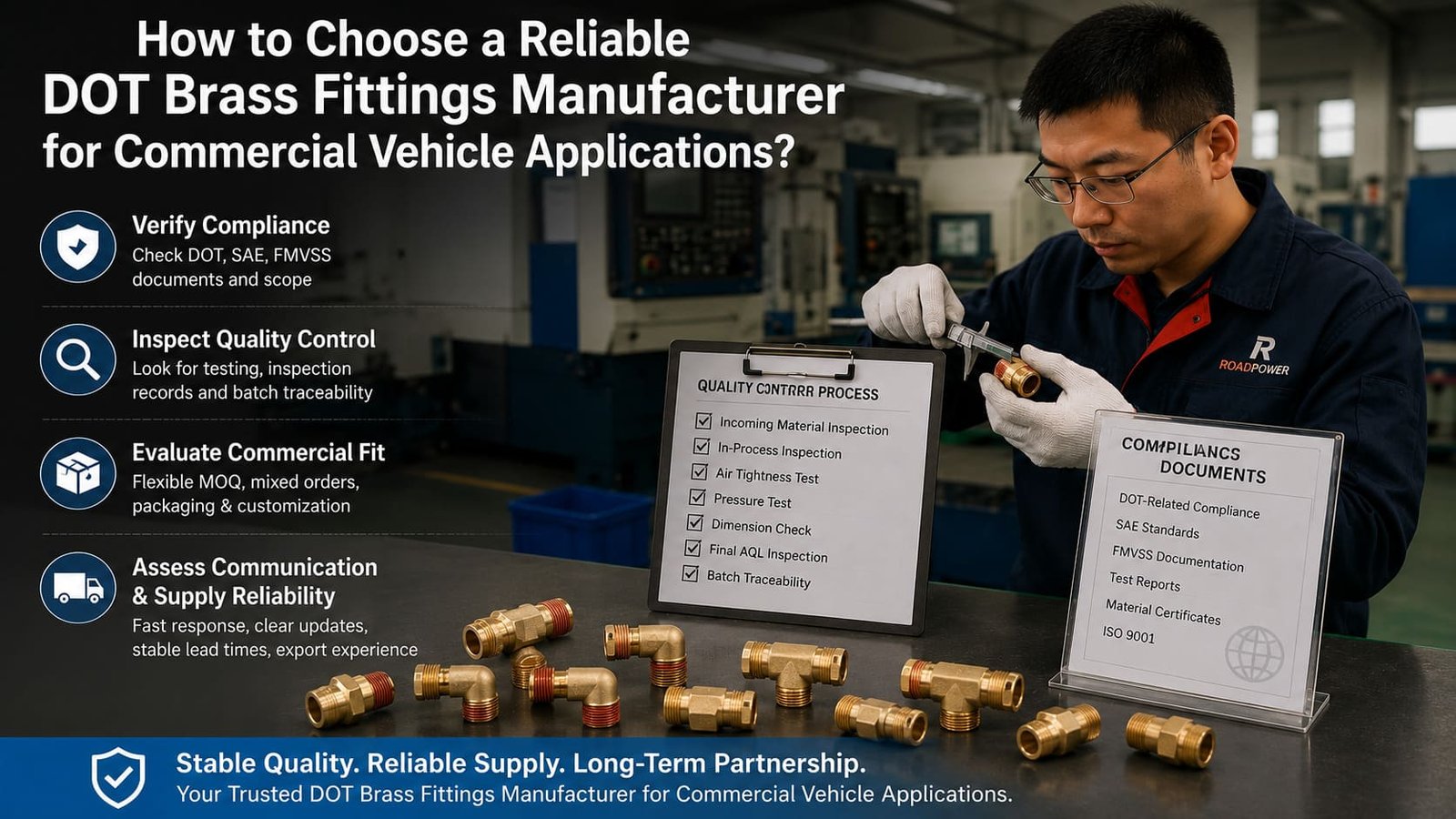
A manufacturer can prove bulk quality consistency through incoming material inspection9, controlled production SOPs, in-process sampling, air-tightness testing, pressure resistance checks, final AQL inspection10, 100% inspection for key products, and traceable batch records from raw material intake to shipment.
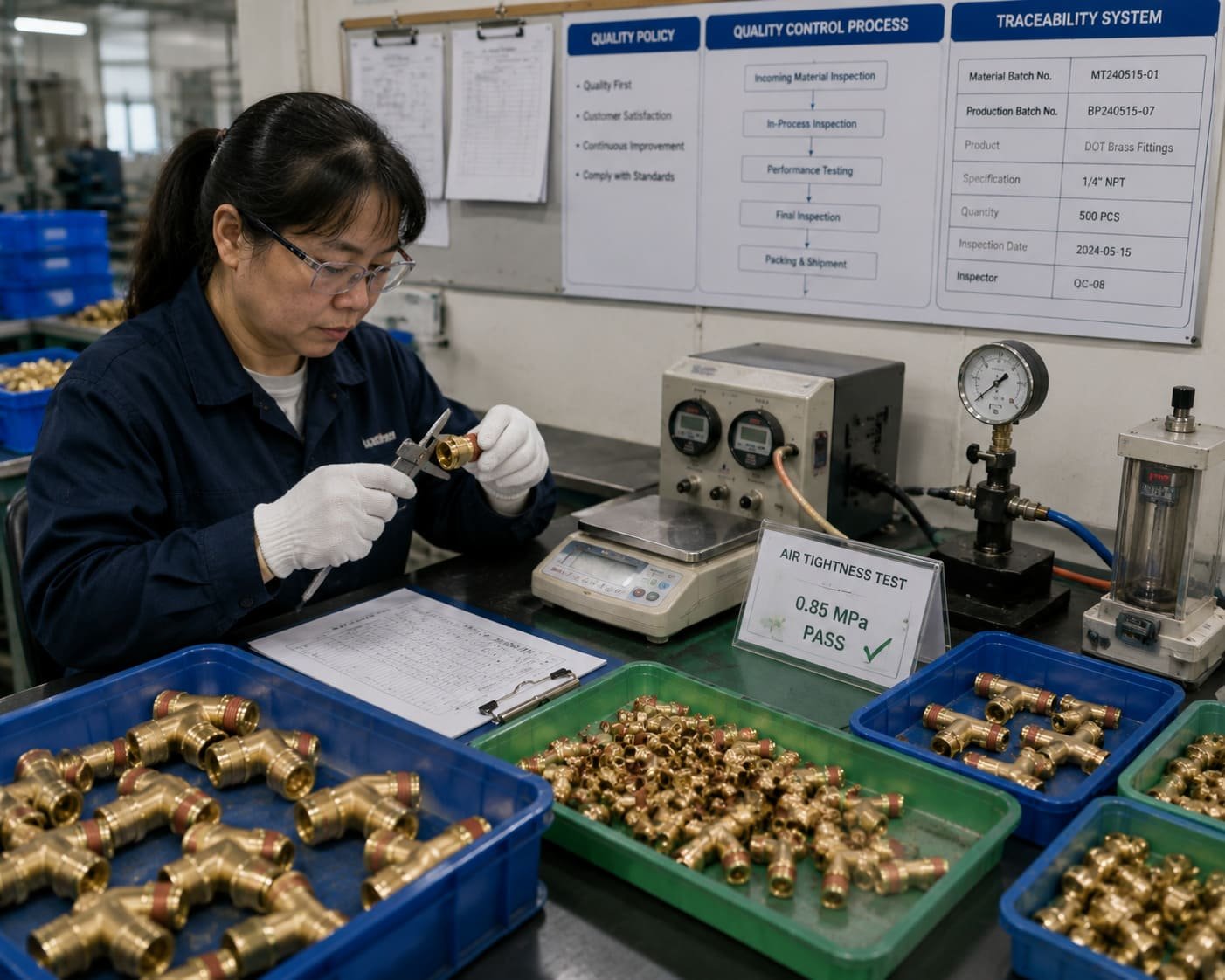
Quality Is a Process, Not a Surface Finish
A brass fitting can look bright and smooth but still create problems. Thread accuracy, sealing performance, material stability, and assembly precision matter more than appearance alone. I usually tell buyers to check what happens before the product reaches the carton.
A practical quality process should include:
-
Incoming material inspection
The supplier should inspect brass, copper, rubber, and metal materials. Batch certificates should be checked and archived. -
Mold and machining control
Dimensional stability depends on tooling, machining precision, and wear control. -
In-process sampling
Operators and QC staff should measure samples during production, not only at the end. -
Performance testing
Air-tightness, pressure resistance, temperature resistance, and tensile strength may be relevant depending on the product. -
Final inspection
Finished goods should be checked before warehousing and shipment. -
Traceability
Batch records should connect raw materials, production date, inspection data, and shipment.
Questions I Ask During Supplier Evaluation
When I help customers think through procurement, I prefer direct questions. These questions reveal whether the supplier really controls production:
- What material grade do you use for this brass fitting?
- Can you provide material batch records?
- What is your inspection frequency during production?
- Which dimensions are critical for sealing and fitment?
- How do you test air leakage?
- Do you separate nonconforming parts immediately?
- Can you trace one carton back to a production batch?
- What happens if a customer reports leakage in the field?
The answers do not need to be overly complicated. They need to be clear, specific, and consistent.
Example of a Strong QC Flow
At BOERAY TRUCK PARTS, we work under ISO 9001 quality management and manage core processes in-house. I mention this not as a sales pitch, but as an example of the type of evidence buyers should look for. For our truck and trailer parts production, we use incoming material inspection, multi-node in-process sampling, performance testing, AQL sampling, and final checks on key products.
A strong QC flow may look like this:
| Production Stage | Control Point | Buyer Benefit |
|---|---|---|
| Raw material intake | Material certificate verification | Reduces material inconsistency |
| Machining or forming | Dimensional checks | Reduces thread and fitment complaints |
| Assembly | Sealing and component checks | Reduces leakage risk |
| In-process inspection | Sampling by SOP | Catches problems early |
| Performance test | Air-tightness or pressure test | Supports functional reliability |
| Final inspection | AQL or 100% check for key items | Reduces defective shipment risk |
| Packing | Label and quantity verification | Reduces warehouse and sales errors |
A reliable DOT brass fittings manufacturer should not be offended by quality questions. Good manufacturers usually welcome them because stable buyers care about stable supply.
What Commercial Capabilities Should a DOT Brass Fittings Manufacturer Offer?
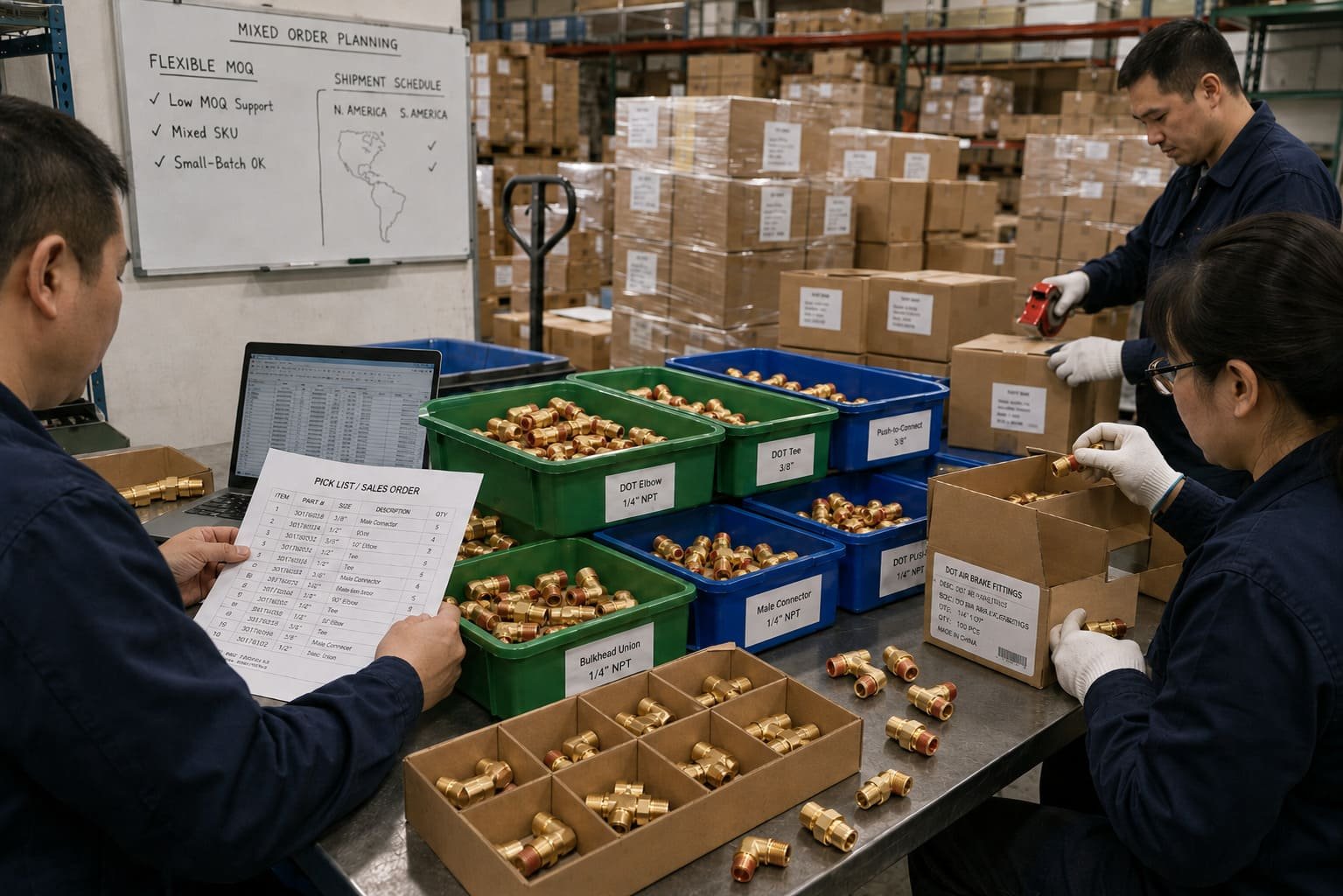
A technically capable supplier can still be a poor fit if the commercial model does not match your business. Distributors, repair shop suppliers, parts stores, and fleet buyers often need mixed SKUs, flexible cartons, private labels, and predictable shipment planning. I see this issue often in aftermarket sourcing.
A reliable DOT brass fittings manufacturer should offer flexible MOQ, mixed small-batch orders, customization by sample or drawing, packaging support, repeat-order planning, and experience with North and South American shipping requirements. Commercial fit helps buyers protect inventory turnover and customer service levels.
Commercial Fit Is About Inventory Risk
A truck parts distributor does not only buy fittings. The distributor manages shelves, cash flow, customer urgency, and repeat demand. A repair shop may need fast-moving items immediately. A fleet procurement team may care about standardization and fewer supplier problems.
This means a supplier should support how you actually sell and use parts.
Important capabilities include:
- Flexible MOQ for urgent or trial orders
- Mixed small-batch orders for broad SKU coverage
- Full-container wholesale support for high-volume distributors
- Custom packaging for retail or private-label channels
- Sample or drawing-based development for special needs
- Stable lead times for reorder planning
- Shipping experience for North and South American markets
A supplier with rigid order rules may still be suitable for some buyers. However, many aftermarket customers need flexibility because demand spreads across many part numbers.
Why Mixed Orders Matter in the Aftermarket
The heavy-duty truck aftermarket is different from single-model OEM purchasing. Distributors may sell to Freightliner, Kenworth, Peterbilt, International, Volvo, and Mack customers at the same time. They may also serve trailer repair shops and regional fleets. This creates a wide SKU mix.
A buyer may need:
| Buyer Type | Typical Need |
|---|---|
| Parts distributor | Wide assortment, stable packaging, repeat shipments |
| Wholesaler | Competitive bulk cost and container planning |
| Repair shop owner | Fast-moving SKUs and reliable fitment |
| Parts store | Clean labels and sellable packaging |
| Fleet buyer | Consistent supply and fewer maintenance complaints |
A practical manufacturer should understand these buying patterns. The supplier should not force every buyer into one order model.
Packaging and Labeling Can Reduce Complaints
Packaging may seem simple, but it affects sales and after-sales service. Wrong labels, poor carton strength, or unclear size markings can create avoidable problems. I have seen buyers lose time because warehouse staff had to relabel mixed items before distribution.
Buyers should ask:
- Can the supplier provide neutral packaging?
- Can the supplier support private-label packaging?
- Can the carton label show part number, size, and quantity clearly?
- Can the supplier separate SKUs cleanly in mixed shipments?
- Can the supplier help design packaging for retail display?
At BOERAY TRUCK PARTS, we support co-development and packaging design when needed. We also handle mixed orders and full-container wholesale. I include this because it reflects a broader point: commercial reliability is part of product reliability.
A reliable DOT brass fittings manufacturer should help your purchasing team, warehouse team, and sales team work with fewer mistakes.
How Should Buyers Evaluate Communication, Lead Time, and Cross-Border Supply?
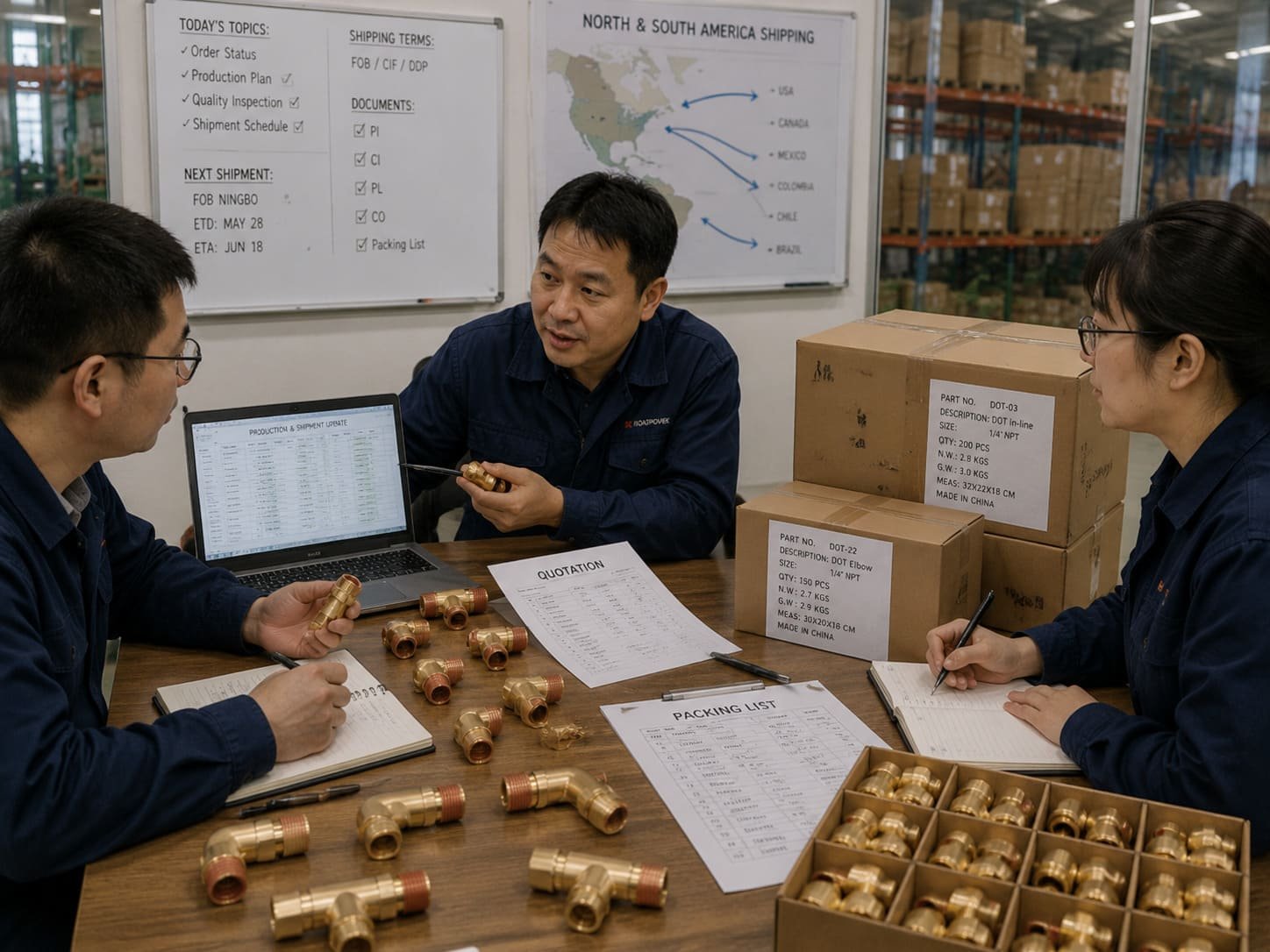
A supplier may have good products but still cause pressure if communication is slow or shipment planning is weak. Cross-border procurement has moving parts. Production, inspection, packing, customs, shipping schedules, and delivery terms all affect whether your inventory arrives when your customers need it.
Buyers should evaluate communication and supply reliability by checking response speed, quotation clarity, production updates, lead-time history, export experience, delivery term options, customs knowledge, and the supplier’s ability to maintain safety stock or production capacity for repeat orders.
Good Communication Prevents Expensive Surprises
I have learned that buyers do not expect suppliers to solve every problem instantly. They expect suppliers to communicate early and honestly. Silence creates more damage than a small production issue.
A reliable supplier should provide:
- Clear quotation details
- Confirmed material, size, thread, and packaging information
- Sample feedback and technical clarification
- Production schedule updates
- Inspection status before shipment
- Packing list and carton details
- Shipping document support
- Fast response when after-sales questions appear
When buyers serve repair shops and fleets, they need accurate information. A delayed reply can delay a repair, a resale order, or a container plan.
Lead Time Should Match Production Reality
A good lead time is not always the shortest lead time. A good lead time is realistic and repeatable. Buyers should be careful when a supplier promises extremely fast delivery without explaining capacity, stock status, or inspection timing.
A manufacturer should be able to explain:
- Whether the item is in stock or made to order
- How long raw material preparation takes
- How long production and inspection take
- Whether packaging requires extra time
- When goods can reach the port
- Which delivery terms are available
For example, BOERAY TRUCK PARTS is located about 30 km from Ningbo Port. That location helps with export logistics, but I still believe buyers should ask for realistic schedules. Production capacity, order mix, and packaging requirements all influence timing.
Cross-Border Experience Matters
North American and South American buyers often face different shipping and customs conditions. A supplier with experience in these markets can help reduce avoidable delays.
Useful experience includes:
| Supply Area | Why It Helps Buyers |
|---|---|
| FOB shipments | Buyers can manage freight through their own forwarder |
| DDP options | Smaller buyers can simplify landed-cost planning |
| Customs document support | Import processes become smoother |
| Mixed container planning | Buyers can combine brass fittings with other parts |
| Safety stock planning | Repeat orders become more stable |
| Market familiarity | Supplier understands truck aftermarket SKU demand |
A reliable DOT brass fittings manufacturer should not only make parts. The supplier should help you maintain inventory flow.
In our experience, buyers with annual procurement volumes from USD 10,000 to several hundred thousand USD often need different service models. Some buyers want small mixed orders to test the market. Others want scheduled container shipments. A manufacturer with flexible systems can support both without making the buyer redesign their whole procurement process.
Frequently Asked Questions
What is the most important factor when choosing a DOT brass fittings manufacturer?
The most important factor is stable risk control. Buyers should verify compliance documents, quality inspection records, batch traceability, and bulk-order consistency. Price matters, but it should not replace evidence of material control, air-tightness testing, pressure checks, and reliable repeat supply.
Does DOT documentation guarantee that every brass fitting will be problem-free?
No, DOT-related documentation does not guarantee every fitting will be problem-free. Buyers should check the document scope, applicable product family, test conditions, and issue date. They should also verify ongoing quality control, because daily production consistency depends on process management.
Should I choose a manufacturer or a trading company for DOT brass fittings?
A manufacturer can offer stronger process visibility, customization, and batch traceability when it controls production directly. A trading company may still be useful in some cases. Buyers should compare evidence, not labels. The best supplier is the one that can prove stable quality and reliable support.
What tests should I ask for before ordering DOT brass fittings in bulk?
Buyers should ask about air-tightness testing, pressure resistance testing11, dimensional inspection, thread checks, material verification, and final AQL inspection. The exact test scope depends on the fitting type and application, so buyers should confirm which tests apply to the ordered product.
Can a DOT brass fittings manufacturer support private-label packaging?
Yes, many capable manufacturers can support private-label packaging, neutral cartons, custom labels, and SKU-specific packing. Buyers should confirm artwork requirements, MOQ, lead time, carton strength, barcode needs, and mixed-order separation before placing the bulk order.
Conclusion
Choosing a reliable DOT brass fittings manufacturer is not just a sourcing task. It is a risk-control decision that affects compliance confidence, leakage complaints, inventory turnover, and customer trust. I recommend that buyers verify document scope, inspect quality control evidence, test bulk consistency, and confirm commercial fit before comparing final prices. If you source heavy-duty truck aftermarket parts for North or South America, contact BOERAY TRUCK PARTS to discuss DOT brass fittings, mixed orders, customization, and stable cross-border supply.
"Interpretation ID: 04-009159drn", https://www.nhtsa.gov/interpretations/04-009159drn. FMVSS No. 106, codified at 49 CFR § 571.106, establishes federal requirements for brake hoses, brake hose assemblies, and brake hose end fittings, providing regulatory context for documentation requests involving air-brake-related components. Evidence role: definition; source type: government. Supports: A government source should identify the scope of FMVSS No. 106 and its relevance to brake hoses, hose assemblies, and associated fittings.. ↩
"How does ISO 9001 support traceability requirements in ...", https://connect981.com/faqs/how-does-iso-9001-support-traceability-requirements-in-manufacturing. ISO 9001 includes requirements for identification and traceability where necessary to ensure conformity, supporting the use of batch records to link materials, production, inspection, and shipment information. Evidence role: mechanism; source type: institution. Supports: A quality-management source should support that identification and traceability enable organizations to preserve conformity information and trace outputs where required.. ↩
"The Economic Impacts of Inadequate Infrastructure for Software Testing", https://www.nist.gov/document/report02-3pdf. Cost-of-quality frameworks classify rework, sorting, warranty claims, returns, and customer dissatisfaction as internal or external failure costs, supporting the view that supplier selection affects total procurement risk beyond unit price. Evidence role: general_support; source type: institution. Supports: A quality-management source should support that procurement decisions can create hidden internal and external failure costs such as rework, returns, warranty claims, and customer dissatisfaction.. Scope note: This is contextual support for the cost categories and does not quantify the specific cost impact of DOT brass fitting failures. ↩
"NIST/SEMATECH Engineering Statistics Handbook Chapter 6", https://www.nist.gov/publications/nistsematech-engineering-statistics-handbook-chapter-6-process-or-product-monitoring. Statistical quality-control guidance treats sample results as evidence about a process rather than proof of all future output, and emphasizes monitoring process variation over time to assess production stability. Evidence role: mechanism; source type: government. Supports: A source should explain that samples estimate process performance with uncertainty and that stable production requires monitoring variation over time.. Scope note: This supports the general quality-control logic and is not specific to brass fittings or commercial vehicle aftermarket procurement. ↩
"Understanding NHTSA's Regulatory Tools", https://www.nhtsa.gov/sites/nhtsa.gov/files/documents/understanding_nhtsas_current_regulatory_tools-tag.pdf. NHTSA explains that manufacturers certify their vehicles or equipment as compliant with applicable federal safety standards and that the agency does not generally pre-approve products, supporting caution toward generic “DOT” marketing claims. Evidence role: expert_consensus; source type: government. Supports: A government source should support that NHTSA generally relies on manufacturer self-certification rather than pre-approval, making product-specific context important.. ↩
"Federal Motor Vehicle Safety Standards; Brake Hoses", https://www.federalregister.gov/documents/2004/12/20/04-27088/federal-motor-vehicle-safety-standards-brake-hoses. SAE standards such as J844 for nonmetallic air brake tubing and J2494 for push-to-connect tube fittings provide recognized technical references for components used in vehicle air brake systems. Evidence role: definition; source type: institution. Supports: A standards source should show that SAE publishes technical standards covering air brake tubing and push-to-connect tube fittings used in heavy vehicle pneumatic brake systems.. Scope note: The applicability of any SAE standard still depends on the exact fitting design, material, and intended application. ↩
"List of CPSC-Accepted Testing Laboratories", https://www.cpsc.gov/cgi-bin/labsearch/. ISO/IEC 17025-based laboratory reporting requirements include identification of the item tested, methods used, and reported results, supporting the need to verify whether a certificate or test report covers the specific product being purchased. Evidence role: general_support; source type: institution. Supports: A conformity-assessment source should support that test reports identify the item tested, methods used, and conditions, so the relevance of a report depends on its scope.. Scope note: This supports the principle of scope verification; it does not determine whether any individual supplier document is valid. ↩
"Quality management system", https://en.wikipedia.org/wiki/Quality_management_system. ISO 9001 frames product conformity as the result of a quality management system that controls processes, monitors performance, and addresses nonconformities, supporting the distinction between one-time compliance evidence and ongoing production control. Evidence role: mechanism; source type: institution. Supports: A quality-management source should support that consistent output depends on controlled processes, monitoring, measurement, and corrective action, not only one-time documentation.. Scope note: ISO 9001 supports the management-system principle but does not itself certify the performance of a particular brass fitting. ↩
"Supplier Scouting | NIST", https://www.nist.gov/mep/supply-chain/supplier-scouting. Quality-management standards require control of externally provided products and services, including verification activities where necessary, supporting incoming material inspection as a mechanism for reducing material-related variation. Evidence role: mechanism; source type: institution. Supports: A source should support that organizations control or verify externally supplied materials to ensure conformity of finished products.. Scope note: This is general manufacturing-quality support and does not specify the exact inspection protocol for brass fitting alloys. ↩
"ISO 2859-1", https://chemistry.unt.edu/~tgolden/courses/iso2859-1.pdf. Acceptance-sampling standards such as ISO 2859-1 and ANSI/ASQ Z1.4 define AQL-based inspection procedures for deciding whether lots meet specified attribute-quality criteria. Evidence role: definition; source type: institution. Supports: A standards source should define AQL or acceptance quality limit as part of acceptance sampling inspection by attributes.. Scope note: AQL sampling reduces but does not eliminate the possibility that nonconforming units remain in an accepted lot. ↩
"49 CFR 571.106 -- Standard No. 106; Brake hoses.", https://www.ecfr.gov/current/title-49/subtitle-B/chapter-V/part-571/subpart-B/section-571.106. Federal brake hose requirements include performance criteria related to pressure and leakage for brake hose assemblies and end fittings, supporting the relevance of air-tightness and pressure-resistance evidence for air-brake-related components. Evidence role: general_support; source type: government. Supports: A government or standards source should show that brake hose or air-brake component standards include pressure and leakage-related performance requirements.. Scope note: The federal standard may apply directly to covered brake hose assemblies and end fittings; its relevance to a separate brass fitting depends on the component’s regulated status and application. ↩